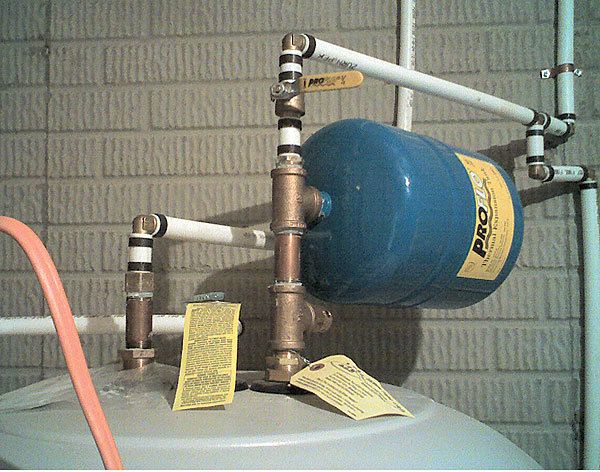
An expansion tank, such as the one shown above, helps to absorb water pressure that results from thermal expansion. The tank can be installed anywhere in the cold-water line between the house’s main valve and water heater, or on the hot-water line within 3 ft. to 5 ft. of the water heater. An expansion tank should be installed in conjunction with a pressure-reducing valve in high-pressure situations.
Q:
I’m installing a hot-water expansion tank. Do I install it in the hot-water line or in the cold-water line? How far from the shutoff valve does the tank need to be to meet code?
James Heather, via email, None
A:
Georg Efird, owner of A2Z Plumbing Inc. ( www.eatsleepplumb.com ) in Asheville, N.C., replies: Your question is a common one, even among plumbers and builders. First, it’s important to understand that the tank’s purpose is to reduce thermal expansion. In a water line, thermal expansion occurs when the water is heated and pressurized. Most expansion tanks use a small volume of air separated by a diaphragm that absorbs the increased pressure.
The tanks are most common in high-pressure water systems and are often required by code. If your water heater is leaking or dripping from the pressure-relief valve on the top or the side, it’s probably because the system does not have an expansion tank or a pressurereducing valve.
Most plumbers install expansion tanks in the hot-water line close to or at the water heater. It seems they do this to use the shutoff valve at the water heater for servicing the expansion tank, or because they simply don’t know there are other options.
Contrary to this common practice, the expansion tank can be installed in the cold-water line. It should be located in the largest pipe closest to the incoming main after a pressurereducing valve. Install an isolation valve near the expansion tank so that the tank can be serviced when needed.
Have the tank checked over annually by a licensed plumber, and make sure it always has the specified air pressure inside it. Some local plumbing codes require that the tank be within 3 ft. to 5 ft. of the water heater on the hot- or cold-water side to ensure that the tank is not concealed. Contact a plumber or plumbing official to be sure you are meeting or exceeding local code.


















View Comments
quoting from the installation instructions for Extrol expansion tanks: "Though product can be mounted horizontally, this can decrease the life of the product."
Also, from the ProFlo (the brand pictured in the article) instructions: : "If vertical installation is impractical, PFXT tank may be installed
in a horizontal position as long as the tank weight is fully supported
independent of the piping. The support can be in the form of
strapping or a support platform. ABSENCE OF AN INDEPENDENT TANK
SUPPORT WILL VOID THE WARRANTY. "
In a house serviced by a well (not city water) that has a bladder tank to balance pressure and pump use, is this function essentially served by the bladder tank, obviating a need for an expansion tank?
In our City, the Expansion Tank is absolutely required because the City Water Lines now has check valves so the cold water only flows into the house. As the tank water heater does its job, of course, the water expands. Without the expansion tank, the T&P valve leaks some water. Over time the T&P valve can become inoperable and quit serving its most important function....safety relief. Also, the Schrader valve on the expansion tank should be pressurized to 5 psi higher than the incoming water pressure.
"Have the tank checked over annually by a licensed plumber"
Surely you jest. Or you are a plumber or lawyer.