In the United States, the recycling rate for aluminum cans has hovered around 50% for years. Cans that don’t make it into the recycling stream add up: Every three months, it’s enough aluminum to rebuild our entire commercial air fleet.
Perhaps the recycling rate has plateaued because people find separating and storing recyclable items inconvenient. It doesn’t have to be that way. With planning and some readily available cabinet accessories, recycling can be as easy as throwing out the garbage.
Rethink storage priorities
For all the talk of the kitchen serving as the new family room, first and foremost the kitchen is where we store food, dishes, and utensils; prepare and cook meals; and clean up the mess when we’re done. As shown above, these three core functions take place in the work triangle. A recycling station should be included in the work triangle because it’s part of the cleanup routine.
For most homeowners, the biggest challenge in creating a recycling station is finding a place to put all those bulky containers between pickup days. If you are worried about devoting valuable cabinet space to cast-off containers, rethink your storage allocations. Free space in the work triangle by moving infrequently used items to more-distant storage.
Efficient recycling storage is in the work triangle
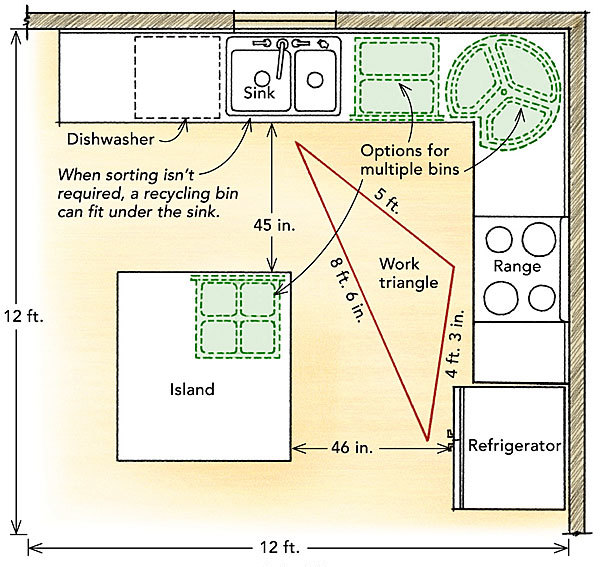
A kitchen recycling center should be within the work triangle and as close to the sink as possible. A little refresher: The three points of the triangle are the refrigerator, the sink, and the range. Traditionally, these storage, prep, and cooking areas have been arranged in a triangle to limit the travel distance between tasks. No leg should be shorter than 4 ft. or longer than 9 ft.; the sum of the legs of the triangle should be between 12 ft. and 26 ft. Because recyclables generally need to be rinsed, keeping recycling bins near the sink eliminates extra steps. Look here first.
If you can’t convert a cabinet to the immediate left or right of the sink, look along the legs of the triangle adjacent to the sink. Inside-corner cabinets are a good option for a recycling center because they typically make awkward storage for pots and pans. Lazy-susan-style holders are available with three or four bins, or you can build a custom pullout recycling station.
Recycling basics
Consider several things when you’re planning a recycling station. First, how frequently are recyclable items picked up or driven to the transfer station? How many recyclables do you generate between pickups?
Next, does your municipality require that you sort recyclables? Do you have to put them at the curb in regulation containers? The answers to these questions shape the flow of cans, bottles, plastic containers, and other recyclables through your house.
To meet the bare-minimum disposal needs of a household with weekly pickups of trash and recyclables, you need two 27-quart trash bins: one for garbage, the second for recyclable items. Households with kids and/or pets need larger bins. The two-bin scenario assumes you’re not required to sort recyclables. If you have to sort, you probably need four bins (metal, plastic, glass, and garbage). Even if you separate materials, I suggest avoiding bins smaller than 27 quarts because they fill too quickly. Paper recycling shouldn’t be included in a kitchen work triangle. I recommend an attractive basket under a family-room end table or in a home-office area where newspapers and magazines are usually read.
I try to locate a kitchen recycling center close to the sink. This placement makes rinsing out containers and disposing of them seamless. The two mostlogical choices are an undersink cabinet or a cabinet to the side of the sink. For a double-bin pullout, you need a minimum 15-in. base cabinet. A four-bin pullout requires at least a 24-in. opening (a 27-in. base cabinet).
If you’re setting up a recycling station in an existing kitchen where the cabinets adjacent to the sink aren’t available, try taking over some base cabinets that are too small for storing pots and pans easily.
Corner cabinets are awkward for utensil and appliance storage, but they can be converted to efficient recycling storage. One off-the-shelf option is a lazy-susan-type rack that holds three bins.
Making recycling work in a small kitchen
If your kitchen is so small that you can’t devote a 15-in. cabinet to a pair of recycling bins, you probably wish you had more counter space as well. A mobile prep cart could be a solution to both of these problems. As shown in the drawing on p. 100, modified drawer frames on each end of the cart can hold bins for recyclables or garbage. Your challenge will be finding floor space to park the cart.
When recycling storage must be outside the kitchen, consider the path recyclable materials take through the house. Because recyclables typically move from the kitchen to the car or the curb for transit to the local recycling center, a point of storage convenient to your garage could be the next-best option. This location could be the garage itself, a mudroom, or a laundry area. Many homes have extra sinks in these spaces, providing a convenient place to rinse recyclables before storage and pickup.
In these locations, you can use a trash bin, your communityissued curbside container, or a repurposed container.
A laundry room adjacent to the kitchen and garage is ideal because it has a water supply. In a mudroom, the interior of a flip-up bench can be divided to hold recycling containers and still match the existing cabinetry in the room.
A cart adds a recycling center to a small kitchen
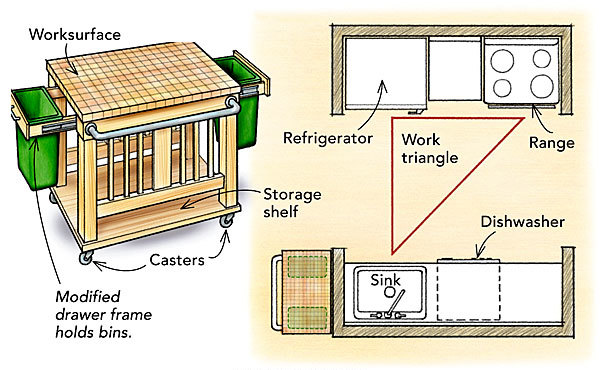
Cabinet space is usually at a premium in a small kitchen, so giving up a 15-in.-wide cabinet to store empty bottles andcontainers might be a tough pill to swallow. In kitchens this small, counter space is also at a premium; you might be able to kill two birds with one work cart. The cart provides workspace on the top, slide-out recycling bins at waist height, and a storage shelf below. The cart can be wheeled into the work triangle when needed.
Recycling outside the kitchen
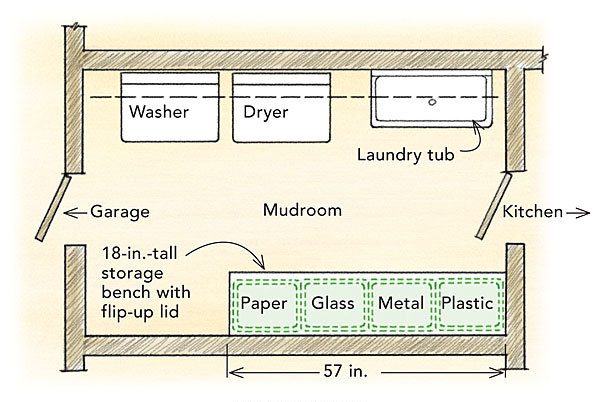
When you can’t find space in the work triangle for a recycling center, look at the route that recyclable materials take through the house. For many people, kitchen bins are a way station before recyclables are moved to the curb. If your curbside bins are kept in the garage, you might find room in a mudroom between the kitchen and the garage. One solution that I’ve used with success is a bench with bins under a hinged lid. The same bench design also works on a back porch off the kitchen.
Sources:
If you’re looking for hardware and other products that can help create a recycling center, these Web sites are a good place to start.