Boosting Tankless Water Heaters
A solar water heater and radiant-floor heat maximize efficiency

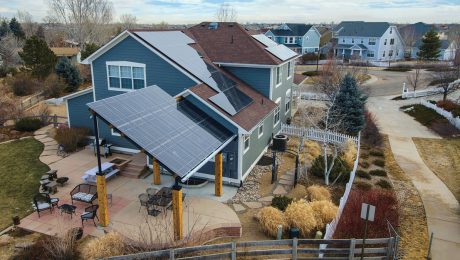
If your teenagers subscribe to the philosophy of, “Why get out of the shower if it never runs out of hot water,” you need to consider boosting your system with a solar water heater and radiant-floor heat. Luckily, it’s easy and economical, especially with the current tax credits available.
Because incorporating both a small tank-type water heater and a powerful pump in your system creates an endless supply of hot water at a consistent pressure and temperature, you can expect your family to sing longer in the shower than they used to, and not get soaked with energy costs.
Here’s what you need to know
Plumb the solar water heater into the line running from the water heater to the cold-water inlet of the demand water heater. It’s important to note that once you hook up a solar-heated water tank, you really need a demand water heater, such as one from Rinnai America Corp., that can measure the temperature of the incoming water and modulate the flame to heat only as much as needed to meet the desired output temperature. Not all demand water heaters can do this, so do your research. Set the output temperature on the solar panel to about 160°F. When the pump cycles (it won’t cycle for long), the heated water will flow through the water heater to the tempering tank.
I’ve noticed in homes with solar hot water, under normal load conditions (a couple of showers and dishes most days), the tanks often meet their high-limit cutoff in the middle of the day. Many days start out with hot water in the solar storage tank from the day before, even if it’s cold enough outside that the furnace is fired up and is heating the house.
By linking the solar hot water to a section of radiant floor, you can dump that excess heat into the house. Every Btu from the sun that you use to heat the home is a Btu you don’t have to buy from a utility company. By dumping the heat from the sun into the floor when appropriate, you can keep the solar tank cool so that when the sun comes out, you will have somewhere to put the heat. (Everybody asks me if the house will get too hot in the summer. If the thermostat doesn’t call for heat, it will just accumulate in the solar storage tanks.) Because the water heater is a capable backup, you can use all the solar Btus for space heating and still not have to worry about having enough hot water to take a shower, or 10 showers in a row if the need should arise.
Note that the upper radiant-heating loop is a staple-up loop under a wood floor, and it runs hot while the lower is a slab loop that has a pump running 24/7, circulating the water in the slab to keep the average temperature of that water lower than the temperature of the water in the staple-up loop.
My sketch is for a closed system that uses a small stainless-steel flat-plate heat exchanger to transfer Btus from the tempering tank to the floor loop without running domestic water in the floor. When any of the Taco 006 circulators are activated by the room thermostats, the motion of the water through the heat exchanger triggers the flow switch and activates the pump that circulates water through the solar storage tank and then through the water heater. Finally, the water moves into the tempering tank and through the heat exchanger. This circulation system ensures that the tempering tank will never be cooled by the floor and that the floor will always send cooled water into the solar storage tank to keep its temperature as low as possible to optimize heat exchange from the collector.
For an even more in-depth discussion and instruction on how to apply Chandler’s methods to your own heating system, visit his Web site at http://www.chandlerdesignbuild.com/files/demandWaterHeaters.pdf.
And to learn more about optimal water heater systems, read Why Add a Tank to a Tankless Water Heater? from Fine Homebuilding Issue #192 (Dec 2007/Jan 2008), pp. 82-85.



















View Comments
An interesting engineering solution. Modern solar collectors can perceive both direct and diffuse solar radiation. The installation of a solar collector alone, for heating cold water, can be ineffective (such systems are most effective in climatic zones with a significant level of solar radiation). But if you use a solar collector and an electric water heater (or another type of water heater), you can really save energy resources in the form of electricity, gas, etc. For heating cold water will be spent a smaller amount of thermal energy. But to design and install such system is very difficult, if you do not have the necessary knowledge and skills. Therefore, it is better to seek the help of professional contractors. A suitable company for the installation of water heaters and related systems can be found on the website - https://contractorfinder.bradfordwhite.com/contractors. You can find a large list of relevant companies.