previous
  • 9 Design Ideas & Tips for Concrete Countertops
    9 Design Ideas & Tips for Concrete Countertops
  • 7 Small Bathroom Floorplan Layouts
    7 Small Bathroom Floorplan Layouts
  • Buyer's Guide to Decking
    Buyer's Guide to Decking
  • Fine Homebuilding: The Digital Issues
    Fine Homebuilding: The Digital Issues
  • Complete Kitchen and Bath Guide
    Complete Kitchen and Bath Guide
  • Deck Design & Construction Showcase
    Deck Design & Construction Showcase
  • Energy-Smart Details
    Energy-Smart Details
  • Painting Ideas, Tips, and Techniques for a Professional Finish
    Painting Ideas, Tips, and Techniques for a Professional Finish
  • The Inspector Game: Decking Dos and Don'ts
    The Inspector Game: Decking Dos and Don'ts
  • 15 Coffered Ceiling Design Ideas and Tips
    15 Coffered Ceiling Design Ideas and Tips
  • Guide to Paperless Drywall
    Guide to Paperless Drywall
  • 10 Basement-Remodeling Tips and Techniques
    10 Basement-Remodeling Tips and Techniques
  • 13 Door Design and Installation Tips
    13 Door Design and Installation Tips
  • Outdoor Kitchen Design Inspiration
    Outdoor Kitchen Design Inspiration
  • Roofing articles, videos, tools, and materials
    Roofing articles, videos, tools, and materials
  • How it Works
    How it Works
  • 12 Remodeling Secrets Revealed
    12 Remodeling Secrets Revealed
  • Meet the Fine Homebuilding Project House!
    Meet the Fine Homebuilding Project House!
  • 7 Solutions for Kitchen Layout and Design
    7 Solutions for Kitchen Layout and Design
  • 2012 HOUSES Awards
    2012 HOUSES Awards
next
Pin It

Dedicated Collets vs. Collets with Inserts

One type is easier to use; the other is easier to lose
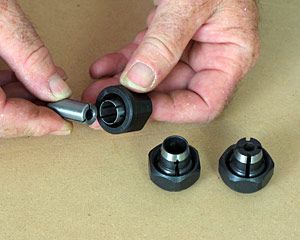
The following was originally intended as a sidebar in Gary Katz's survey of plunge routers, "Taking the Plunge," in the December 2001/January 2002 issue of Fine Homebuilding. Regrettably, we had to cut this sidebar from the article for space reasons, but we're happy to be able to present it on the Web.

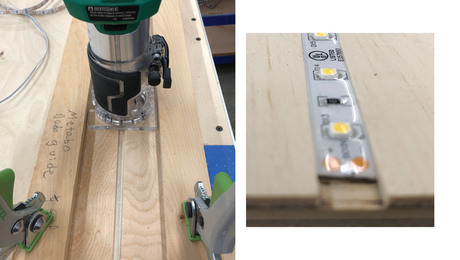
Most small routers are equipped with only a 1/4-in. collet, but most routers 2 hp and larger are equipped with 1/2-in. and 1/4-in. collets, or a 1/2-in collet with a 1/4-in. insert (see the photo above). If you frequently change between 1/2-in and 1/4-in. router bits, consider buying a router with separate collets, such as the Makita RP1101, Bosch 1613EVS or Porter-Cable. The Porter-Cable and Bosch collets are connected to the nut with a c-clip; when the nut is loosened, it pulls the collet with it. No messing with frozen collets. On the other hand, the 1/4-in. inserts are smaller, easy to lose, difficult to install and they can be poorly machined; I even cut my finger on Hitachi's insert.

Gary M. Katz is a carpenter and writer living in Reseda, California. He is the author of The Doorhanger's HandbookPhoto: Charles Bickford

December 1, 2004