A Handle on the Trade: An Interview with Rex Alexander
The Michigan cabinetmaker and designer talks about his work
During his first 10 years in business, Rex Alexander claims he was a perfectionist trying his best to work with an imperfect material. Then a book by James Krenov changed both his mindset and his methods. In an interview with FineHomebuilding.com, Rex explains how, for him, only one thing can top the smell of wood in the shop.
What is your approach to cabinetmaking? What do you do first?
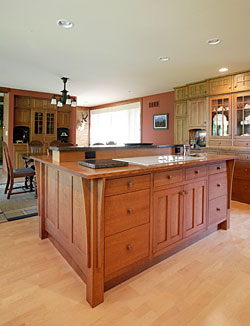
RA: My work is a direct result of the interaction between me and my customer. When I’m called in to build a kitchen or bookshelf or any custom piece, the first thing I do is listen to what the customer wants to accomplish. Many times, we start with a wish list, a budget, and a drawing. If I’ve listened closely and keep the other things in mind, I can create a design that reflects my customers’ lifestyle.
Once I have the measurements and all the information I need, I go to my office and generate detailed drawings along with a “to-the-dollar” estimate for the project. After the estimate is accepted, the next step is to work up the construction drawings before I touch any material in the shop.
Who or what are your design influences? Who inspires you?
RA: I started my business in central Indiana, where the design influence is traditional. My first 10 years were spent working with red oak and raised-panel doors. Then, in 1979, I read A Cabinetmaker’s Notebook by James Krenov and started subscribing to Fine Woodworking magazine. Both expanded my design repertoire and raised the bar on craftsmanship for me. The more I read and learned, the more I became inspired by Greene and Greene, Gustav Stickley, Gerrit Rietweld, Charles Rennie Mackintosh, George Nakashima, Johnny Grey, and many others.
Krenov’s work and writings completely changed my way of thinking and working. They helped me to develop the sensibility to know my materials and to work with and not against them. By studying Krenov, I learned to “compose” wood, and I developed a love for the trade.
Do you have any signature design elements, things that really identify a piece as one only you could have made?
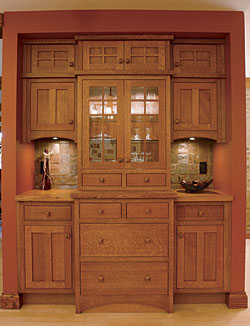
RA: Clients seek me out for my perfectionist’s nature and my use of unique designs and materials. Above all else, they seek me out for superior craftsmanship. My reputation with contractors and residential customers is one of fastidious fussiness. My signature designs include a straightforward, sensible approach to layout and function. I employ clean lines and workable solutions.
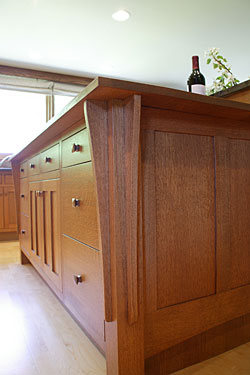
What tricks do you use for customization? How do you keep your designs diverse?
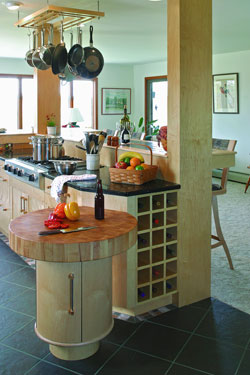
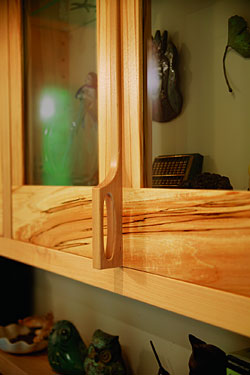
RA: I live in the middle of Manistee National Forest, so I have access to many loggers and sawyers. In Michigan, white birch is plentiful but not considered a viable timber for the hardwood-lumber market. So I often use white birch and other odd, but domestic, species for my kitchens and other projects. It’s not unusual for me to use sassafras, American chestnut, apple wood, Osage orange, and other less common species. Loggers in the area know what I like, and they keep me supplied. Unique materials help me to stand out from the crowd.
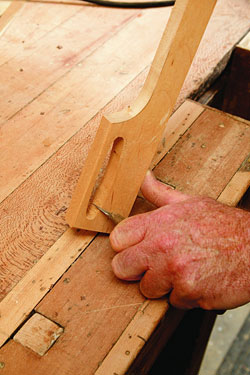
Also, by marrying unexpected shapes and material combinations, I’ve developed many door-handle styles that give each piece I build a custom look; one-of-a-kind handles have become part of my signature style. I’ve created such a multitude of handle styles that it’s not hard to keep each project diverse and interesting.
Three things keep the work I do fresh and inspiring:
1. A willingness to experiment with different materials like wood, concrete, tile, and laminate.
2. An eye toward incorporating interesting offsets, heights, angles, and curves.
3. The opportunity to work with creative customers.
If you had to pick a first love, would it be designing or building cabinets?
RA: The love is in the whole process, both designing and building. If I spend a couple of days or weeks designing in the office, by the end of the stretch, I’m ready to get physical in the shop. The smell of plywood and hardwood—and using the tools—is a real high. But building and selling something you’ve designed is the ultimate high!
Do you have a favorite project? Tool? Material?
RA: Ah, The Bathrick kitchen. You can find the article, A Shapely Kitchen in the August/September 2005 issue of Fine Homebuilding.
For tools, I love hand planes, handsaws, and working by hand-cutting interesting joinery. But I think the tool of the century is the biscuit joiner. You can do just about anything with it. The random-orbit sander would run a close second.
And maple wood is a favorite, but truly, I love them all.
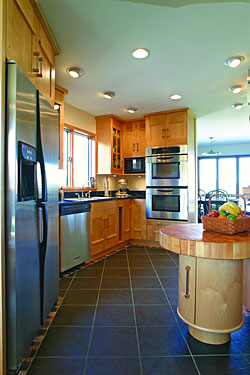
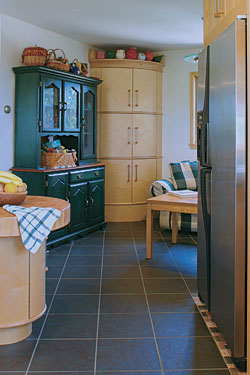
To learn more about Rex’s work, read Signature Details for Kitchen Cabinets from the August/September 2007 issue of Fine Homebuilding.