Clifford A. Popejoy’s article “Is Your Old Wiring Safe?” (Fine Homebuilding #169) explains how to inspect and judge the condition of old electrical wiring. There are things, however, that even the most thorough visual inspections can’t tell you, such as the condition of wiring inside walls and ceilings. For these potential hazards there are specialty testers. Though both of the tools are priced for professionals, they are worth knowing about as they are the closest thing an electrician has to x-ray vision.
If your inspection leads you to upgrading the wiring in your house, you’ll want to meet current codes in your area. Below you’ll find a list of code issues, based on the National Electrical Code, that you should be familiar with.
Specialty testers
Old electrical wiring that’s been badly modified can be a quagmire of poor connections or failing components. Failing splices may be in a hidden junction box or not in a j-box at all. Even a visual inspection of every accessible splice or connection won’t tell me if all the connections are good. Also, old circuit breakers may be frozen and not be able to open under an overload condition. Both bad splices and bad breakers present fire safety hazards. How can an electrician find these problems before they erupt?
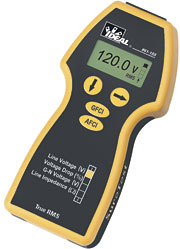
Ideal Industries’ Sure Test — It’s not x-ray vision, but something pretty close. It’s a special tester that puts a 12-amp load across the circuit for a fraction of a second and measures the voltage drop. The voltage drop is proportional to the resistance (actually impedance) in the circuit. So a voltage drop measurement gives an indication of every connection between where I make the measurement and the electrical service entrance.
As I check the voltage drop at receptacle outlets, I expect to see a gradual increase as I get further away from the service entrance. A drastic increase at one point means there’s a bad splice or connection, a damaged wire, or some other source of impedance.
The Ideal Sure Test (www.idealindustries.com) tester is my favorite voltage drop tester, because it does many other kinds of tests. One of these is checking the grounding path impedance under load. This is important with old BX systems where the armor serves as the grounding conductor; the armor and couplings have to be able to pass enough current to clear a fault (by opening the breaker). A polarity tester or a simple continuity test won’t tell you that. The Sure Test also checks the impedance of the hot and the neutral conductors. This guides me in finding the bad connection or splice.
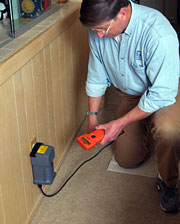
KO Instruments’ CBA 1000 — Some old electrical systems use circuit breakers for overcurrent protection. The circuit breaker is an automatic switch that opens the circuit if too much current flows for the wire size. The breaker keeps the wire from heating up to the point where it starts a fire. These breakers may be 30 or 40 years old, and in some instances may fail to open. Verifying the operation of an old circuit breaker is a good idea, but until recently, there was no safe way to do it for 15 and 20 amp branch circuit breakers. KO Instruments (www.koinstruments.com) has developed a compact, efficient instrument that safely puts a direct short across a circuit and measure the time and current it takes to trip the breaker. It runs a pre-test, measuring voltage drop at 20 amps, and will abort testing if the circuit is too weak to handle the pre-test, or the breaker function test itself.
The CBA 1000 allows me to be confident about leaving old breakers in service. Some old breakers are very expensive to replace, but before I had this tester, it was either leave them and wonder if they’ll work, or replace them at a sometimes extraneous cost. I’ve found breakers that have failed to open under test. As far as I’m concerned, that’s a big deal—better to find it under test, than have a fire or near fire when the breaker fails to open in a real-life short circuit situation.
Old wiring and the code
When you upgrade old wiring or remodel your house, you’ll have to meet the latest electrical codes. Here are some important code requirements, based on the National Electrical Code (NEC), pertinent to upgrading old wiring.
Size of the service — The NEC requires a minimum service size of 100 amps. When I install a new service, 200 amps is the default. Usually only very large houses (4000 sq. ft. or more) require more than 200 amps. I run the service-load calculations to determine this (“Installing an Electrical Service,” Fine Homebuilding #150, pp. 78-85).
Converting nongrounded outlets to grounding — It’s no longer permissible to ground to the closest metallic water pipe. The NEC allows a separate ground wire to be run to an outlet to provide an equipment ground. The added wire must originate from the panel ground bus, and it must closely follow the current-carrying conductors of the circuit. If you’re going to run a wire all the way back to the panel, you might as well run a new cable with ground.
Boxes — Old fixtures sometimes are attached to framing with no electrical box to contain the connections between building wire and fixture wire. The boxes that were used later typically are too small by modern standards. Boxes must be part of a new installation. Old boxes usually need to be replaced to meet code. See “Rough Electrical Wiring,” (Fine Homebuilding #144, pp. 76-81).
Specialized circuits — To meet the demand of modern energy uses, the NEC requires installation of several specialized heavy-duty circuits. For instance, the NEC mandates a minimum of two 20-amp circuits to serve kitchen-countertop outlets, a 20-amp circuit for the laundry, and a 20-amp circuit to serve bathroom receptacles. Requirements like these have to be met when making changes to the wiring in these rooms or areas. They’re smart to make pretty much at any time.
Knob and tube — The NEC prohibits burying knob-and-tube wiring in thermal insulation for a couple of reasons. First, thermal insulation traps the heat created by current, causing the electrical insulation on the wires to degrade and eventually fail. Second, it increases the chance that someone moving around in an attic will damage the wiring because they can’t see it. In adopting the NEC, the State of California reviewed records for any evidence of fires caused by knob and tube in thermal insulation and found none. California and other jurisdictions across the country consequently have softened this prohibition. The California Electrical Code allows knob-and-tube wiring to be surrounded by thermal insulation if it’s inspected by a state-licensed electrical contractor and found to be in good condition, and if a notice is posted in the attic warning of hidden wiring. If you have knob-and-tube wiring in your house, check with your local building department to see if it can be used in thermal insulation.
System grounding — System grounding protects your house and its wiring from energy surges like lightning strikes and high-voltage power-line contact with local distribution lines. The NEC’s requirements for system grounding have changed considerably over the years. This is a big safety issues with residential wiring. When upgrading a service, be sure that the system grounding is brought up to meet requirements in your area.
Clifford A. Popejoy is a California electrical contractor and a frequent contributor to Fine Homebuilding.