Understanding Cabinet Plywood
Back in the old days, veneer-core plywood was your only choice. Not any longer.
It’s no wonder that hardwood plywood long ago supplanted solid lumber as the material of choice for built-ins, cabinets and many kinds of furniture. More stable than solid wood and available in many grades and species, plywood is relatively economical. But if one sheet of rotary-cut plywood looks like another, what’s beneath the face veneer can be as different as maple and marzipan.
Most lumberyards stock veneer-core plywood, a cabinet staple for years. These panels are made by laying up layers, or plies, of wood so that the grain direction in each ply runs at right angles to the one next to it. Cross-grain construction is what gives plywood its strength and dimensional stability. Standard veneer-core plywood 3/4 in. thick consists of seven plies: two outer veneers, plus five hardwood or softwood plies between them.
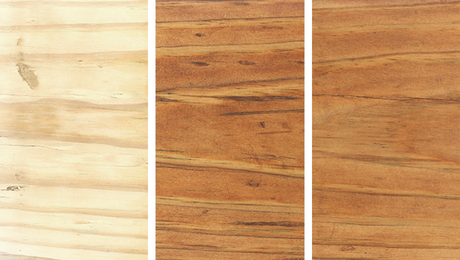
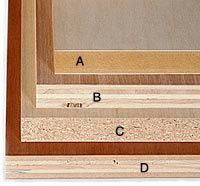
A) MDF core is heavy and flat. Plywood with a core of medium-density fiberboard offers a smooth outer surface. It is about 25% heavier than veneer-core plywood.
B) Veneer-core plywood is strong and light. This 3/4-in. veneer-core plywood is made from five internal plies laid at right angles to each other plus two thin outer veneers.
C) Particleboard is another choice for an engineered core. A particleboard-core panel weighs roughly the same as MDF core, but it is slightly less expensive.
D) Combined-core plywood is a happy compromise. Two layers of MDF and a center of wood plies make for a smooth surface and a strong, flat panel.
Both face and back veneers are available in a variety of species, grades and cuts. A 4-ft. by 8-ft. sheet of veneer-core plywood typically weighs between 60 lb. and 70 lb. Rotary-cut face veneers in U.S.-made sheets are usually between 1/32 in. and 1/38 in. thick. In plywood that was made overseas, some face veneers may be 1/64 in. thick, sometimes less, a trend that makes the most of rare hardwoods but does not encourage a great deal of sanding.
As common as it might be, veneer-core plywood is only one option for cabinet work. Manufacturers also turn out a variety of panels with engineered-wood cores: medium-density fiberboard (MDF), particleboard, oriented strand board and even panels that combine engineered wood with solid-wood plies. What do you get with an engineered-wood core that you don’t get with veneer-core plywood? More weight, lower cost and a flatter panel, says Charles J. Dionisio of Connecticut Plywood Corporation, a distributor.
A 3/4-in. sheet of MDF-core plywood, for example, weighs about 100 lb., a big drawback if you’re hefting panels over a table saw by yourself. A particleboard-core panel is roughly the same. According to the Hardwood Plywood and Veneer Association (www.hpva.org), an industry trade group, both MDF- and medium-density particleboard-core plywood show “excellent” flatness and surface uniformity, compared with only “fair” or “good” ratings for veneer-core panels. Dimensional stability, screw-holding and bending strength of MDF or particleboard panels, however, are rated as “good” or “fair,” compared with the “excellent” marks that veneer-core panels get. Plywood made with engineered-wood cores should cost somewhat less than comparable veneer-core panels.
One potential downside to using panels made with engineered-wood cores, according to Dionisio, is customer reaction. Even though engineered-core plywoods have some advantages over veneer-core panels, some people just don’t like the idea that the panels are not made from all natural wood. Among them may be chemically sensitive folks who react badly to the urea for-maldehyde adhesives used in plywood; the adhesives emit small amounts of formaldehyde as they cure. Rob Simonsen, a manager at Tumac Lumber (425-258-2217), a forest-products distributor in Everett, Washington, says this phenomenon is much less severe than it was a few years ago because of improved glues. However slight, formaldehyde levels are greater in engineered-wood core plywoods than in veneer-core panels, and higher in MDF than in particleboard.
A middle ground between veneer-core and MDF-core or particleboard-core panels is plywood that combines engineered materials with ordinary wood plies. These panels cost about the same as veneer-core plywood, and they are only slightly heavier. And, explains Steve King, vice president of marketing and sales at Washington-based Mt. Baker Plywood (800-822-5211), combination-core panels are helping to solve some pesky manufacturing problems. It’s hard to lay down a flat, uniform face veneer when interior plies have any surface defects in them. In some parts of the country, manufacturers are having an increasingly difficult time producing high-quality veneers for core plies (or, as King put it, getting a “smooth peel”). Veneer plies at the center of the panel give it strength; layers of MDF or particleboard just below the face and back veneers make it smooth and flat.
Doug Knight, customer-service manager at Columbia Forest Products (800-237-2428), a major plywood manufacturer, says the combined-core panels finish better than veneer-core plywood because there are no voids below the face veneer and no defects to telegraph to the top. At the same time, Knight says, plywood with particleboard or MDF cross-banding retains screw-holding advantages of veneer-core plywood.
Some shops have had trouble adjusting to combined-core panels, King says. Because edges are part MDF and part wood, they have a different porosity than straight veneer-core panels. That can disrupt established procedures for gluing on edgebands, for example. Combined-core panels, such as plywood with a straight MDF core, also can bulge slightly where screws are installed. But the real roadblock to wider use of combined-core plywood, King says, is simply a reluctance to try something new.
Former Fine Homebuilding senior editor Scott Gibson is now a freelance writer. Plywood courtesy of Mt. Baker Plywood