previous
  • Patrick's Barn: A Perfect Place for a Party
    Patrick's Barn: A Perfect Place for a Party
  • Top 10 Videos of 2011
    Top 10 Videos of 2011
  • Replacing a Roof : Installing a Ridge Vent
    Replacing a Roof : Installing a Ridge Vent
  • How to Avoid Complicated Fractions
    How to Avoid Complicated Fractions
  • Your Guide to Energy Smart Homes
    Your Guide to Energy Smart Homes
  • The Self-Taught MBA: Inspired Reading
    The Self-Taught MBA: Inspired Reading
  • How to Figure Out Concrete Volume with Sketchup
    How to Figure Out Concrete Volume with Sketchup
  • 10 Basement-Remodeling Tips and Techniques
    10 Basement-Remodeling Tips and Techniques
  • Wanted: Plumber for a Bathroom Remodel
    Wanted: Plumber for a Bathroom Remodel
  • VIDEO: Stop Paint from Bleeding
    VIDEO: Stop Paint from Bleeding
  • 7 Small Bathroom Layouts
    7 Small Bathroom Layouts
  • Seven Steps to Choosing the Perfect Circular Saw
    Seven Steps to Choosing the Perfect Circular Saw
  • How To Make a Reciprocating-Saw Blade Guide Block
    How To Make a Reciprocating-Saw Blade Guide Block
  • The Inspector Game: Goofs on a Roof
    The Inspector Game: Goofs on a Roof
  • Fine Homebuilding: The Digital Issues
    Fine Homebuilding: The Digital Issues
next

Should you switch heating fuels?

BuildingGreen.com has an interactive online calculator to make comparing fuel costs simple
Rising energy prices have made heating fuels that once were affordable seem quite expensive. Heating oil, for example, is projected to average $4.13 per gal. this winter, up 35% from last year, according to the Energy Information Administration’s Web site (www.eia.doe.gov). Both natural-gas and electricity prices are expected to be about 9% higher, too.

Given the statistics and the state of the U.S. economy, it might be tempting to consider switching to a less expensive fuel source. But comparing fuel costs isn’t so simple. In fact, it’s pretty complicated. Fuel is sold by volume or weight, not by energy content. The only way to compare the cost of heating with a gallon of oil to the cost of heating with a kilowatt hour of electricity is to determine the price of each per unit of delivered heat, which is measured in British thermal units (Btu).

Finding the cost per Btu also has to include the efficiency of converting each fuel into heat and the efficiency of the distribution system. An old oil-fired boiler, for example, is about 78% efficient, but electric baseboards are 100% efficient.

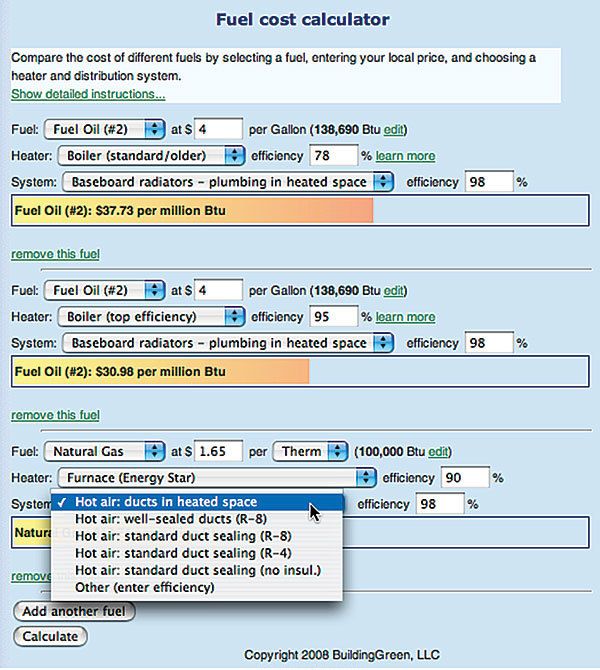
The folks at BuildingGreen.com have developed a sophisticated yet easy-to-use interactive online calculator to make the comparison process simple (www.buildinggreen.com/calc/fuel_cost.cfm). The calculator provides options for comparing fuel oil, electricity, natural gas, propane, firewood, pellets, corn, kerosene, and coal, including various heaters and distribution systems. You’ll find detailed instructions within the calculator as well.

Compare heating-fuel costs in just a few clicks. This interactive tool calculates a heating fuel’s cost per Btu based on the efficiency of the heater and its distribution system. Users can change fuel costs, add multiple fuels, and choose from more efficient heaters (a new 95%-efficient boiler, for example) for comparison. Compare heating-fuel costs in just a few clicks. This interactive tool calculates a heating fuel’s cost per Btu based on the efficiency of the heater and its distribution system. Users can change fuel costs, add multiple fuels, and choose from more efficient heaters (a new 95%-efficient boiler, for example) for comparison.
From Fine Homebuilding200 , pp. 20 November 12, 2008