previous
  • The Inspector Game: Goofs on a Roof
    The Inspector Game: Goofs on a Roof
  • Seven Steps to Choosing the Perfect Circular Saw
    Seven Steps to Choosing the Perfect Circular Saw
  • Replacing a Roof : Installing a Ridge Vent
    Replacing a Roof : Installing a Ridge Vent
  • Buyer's Guide to Insulation
    Buyer's Guide to Insulation
  • 7 Small Bathroom Layouts
    7 Small Bathroom Layouts
  • Tool Test Preview: Compact Compressors
    Tool Test Preview: Compact Compressors
  • 10 Basement-Remodeling Tips and Techniques
    10 Basement-Remodeling Tips and Techniques
  • Fine Homebuilding: The Digital Issues
    Fine Homebuilding: The Digital Issues
  • Roofing articles, videos, tools, and materials
    Roofing articles, videos, tools, and materials
  • Top 10 Videos of 2011
    Top 10 Videos of 2011
  • An Introduction to Thermal Imaging
    An Introduction to Thermal Imaging
  • 7 Solutions for Kitchen Layout and Design
    7 Solutions for Kitchen Layout and Design
  • VIDEO: Stop Paint from Bleeding
    VIDEO: Stop Paint from Bleeding
  • Your Guide to Energy Smart Homes
    Your Guide to Energy Smart Homes
  • How to Avoid Complicated Fractions
    How to Avoid Complicated Fractions
next

Germans take first prize in solar competition

College students design and build nearly net-zero energy homes
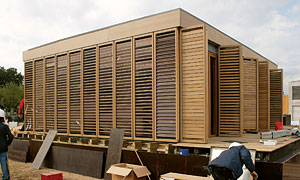
In October 2007, visitors to the National Mall in Washington, D.C., witnessed the construction of the largest solar-powered off-thegrid housing development in the country. Unfortunately, the houses came down almost faster than they went up.

However temporary the effort, the third Solar Decathlon wasn’t about residence in the here and now. It was about education, for both the estimated 120,000 visitors and the 20 university teams from the United States, Spain, and Germany. The teams competed to design and build a home that was solar-powered and as close to net-zero energy as possible in this contest sponsored by the U.S. Department of Energy and a host of building-related concerns.
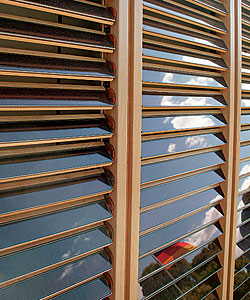
Nobody integrated photovoltaics better than the Germans. The louvered doors on the winning team’s home are equipped with thin-film PV for generating electricity while providing passive cooling. The house is now back in Germany to be used as a solar power plant on campus. Germany has a “solar feed-in tariff” that guarantees a high price for solar power fed into the grid—high enough that the university can sell shares to the public to finance solar power plants. Nobody integrated photovoltaics better than the Germans. The louvered doors on the winning team’s home are equipped with thin-film PV for generating electricity while providing passive cooling. The house is now back in Germany to be used as a solar power plant on campus. Germany has a “solar feed-in tariff” that guarantees a high price for solar power fed into the grid—high enough that the university can sell shares to the public to finance solar power plants.

Competition rules limited the size of the houses to a maximum of 800 sq. ft. Each house’s photovoltaic array had to produce enough power for normal household use as well as sufficient surplus to charge an electric car.

A group of judges scored each entry on 10 areas that included architecture, market viability, energy efficiency, and innovative design. The winners were announced at the end of the weeklong exhibition. First place was awarded to the German team from Technische Universität Darmstadt; the University of Maryland took second; and Santa Clara University placed third.

Speaking to a precompetition gathering, Alexander Karsner, assistant secretary of Energy Efficiency and Renewable Energy (EERE), said that in addition to the 2009 Solar Decathlon, a European competition would be held in Madrid in 2010, the product of an agreement between the EERE and the Housing Ministry of Spain.

For more information, visit the event’s Web site at www.solardecathlon.org.

Magazine extra: View a slideshow to hear participants describe their entries

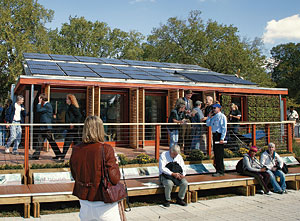
How is this house like a leaf? It converts sunlight into energy. The University of Maryland’s secondplace offering, LEAFHouse, is supposed to mimic a leaf in function and looks. Also, the vertical garden filters rainwater from the roof and feeds a gray-water system that can recycle household wastewater. How is this house like a leaf? It converts sunlight into energy. The University of Maryland’s secondplace offering, LEAFHouse, is supposed to mimic a leaf in function and looks. Also, the vertical garden filters rainwater from the roof and feeds a gray-water system that can recycle household wastewater.
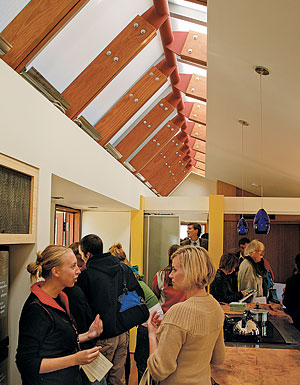
The steel ridge with offset rafters alludes to the veins of a leaf. The steel ridge with offset rafters alludes to the veins of a leaf.
Photos by: Charles Bickford

From Fine Homebuilding193 , pp. 22-24 January 17, 2008