Use of home-energy rating index grows
HERS Index allows more latitude for recognizing reductions in energy consumption
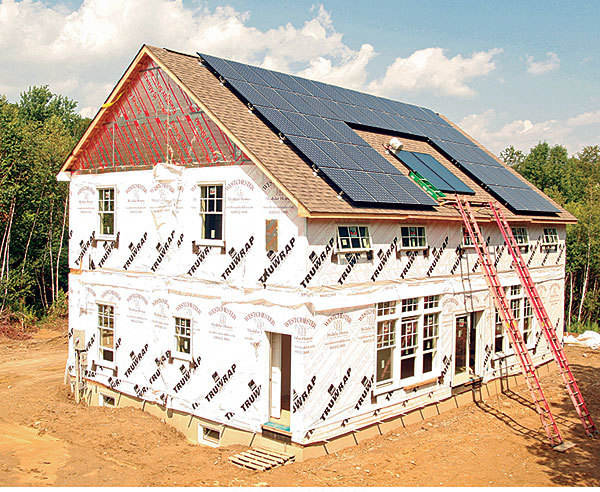
A lower score raises the bar. Along with a tighter building envelope, many builders are adding features like the photovoltaic and solar water-heating panels shown here to lower a home’s HERS score.
Rob Wotzak
While the LEED for Homes rating system from the U.S. Green Building Council has gotten a lot of attention since its 2007 launch, a less complex and less comprehensive rating system has quietly been applied to hundreds of thousands of homes and is referenced by a growing number of programs.
The HERS, or Home Energy Rating System, Index was established by the Residential Energy Services Network (Resnet), a California-based nonprofit (www.resnet.us). Resnet updated the old HERS Score system with the new HERS Index in 2006. HERS compares a home under construction with a reference home that meets the minimum requirements of the 2006 International Energy Conservation Code. The score, which is calculated from a computer model using Resnet-accredited software, also factors in actual measurements from a home: results of a blower-door test, an insulation inspection, and a duct-leakage test for homes with ducts in unconditioned spaces.
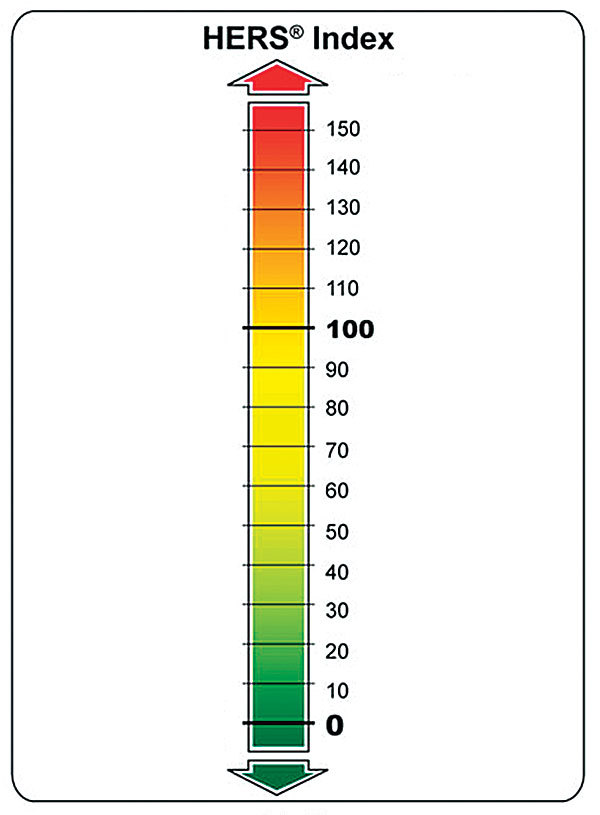
In HERS, lower is better. More and more home-energy rating systems are using the HERS Index as a benchmark of energy efficiency. Scores resulting from measurements that include blower-door tests reference a home built to meet minimum 2006 IECC code requirements. The ultimate score is 0.
Courtesy of Resnet
Steve Baden, executive director of Resnet, explains that the new HERS Index allows more latitude for recognizing reductions in energy consumption. Unlike the old index, which used a score of 80 as the reference home, the new theoretical reference home scores 100, and a net-zero energy home scores a zero.
Index scores correlate with percentage improvements compared with the reference home: An Energy Star home scoring 85 uses 15% less energy than the reference home.
In addition to considering heating, cooling, and hot water, the new HERS Index takes into account energy use for lighting and major appliances as well as renewable energy produced on site. The inclusion of the latter has led builders to use features like photovoltaic panels to lower HERS scores.
Although principally identified with Energy Star, the HERS Index is gaining wider use. It has also been adopted—and rebranded—by the Department of Energy (DOE) in its Builders Challenge program (www.eere.energy.gov), which calls for a HERS score of 70. Despite possible confusion about using the HERS Index, Builders Challenge suggests room for improvement over Energy Star’s threshold of 85.
“If you’re building a good quality building, and you’re putting in good insulation and a good heating system, you’re probably already at the minimum Energy Star level,” says Jay Walsh, an energy analyst with the Center for Ecological Technology in Massachusetts, suggesting that an Energy Star rating is fairly easy to achieve.
But Walsh argues against lowering the Energy Star threshold. Although he tries to help homes achieve the Builders Challenge benchmark score of 70 or better, Walsh says he doesn’t see that as an entry point for Energy Star. Instead, he believes that “the inclusion of as many homes as possible should be the real goal.”
The 2030 Challenge, a campaign for radically improved building performance driven by targets to reduce greenhouse gas emissions, has also adopted the HERS Index, using it to define aggressive benchmarks for residential-energy performance. Architecture 2030 (www.architecture2030.org), the group behind the 2030 Challenge, has called for homes built after 2007 to achieve a HERS Index of 65. That target drops to zero by 2030. LEED for Homes also recognizes the HERS Index as one of two possible compliance paths for its energy-optimization credit.
The widespread adoption of the HERS Index suggests that it is both relatively robust and that it communicates results effectively, and Walsh confirms that “the index is being received well.”
There have been some recent studies, however, showing that actual energy consumption in HERS-scored homes does not accurately reflect their scores. “The primary reason is that there are people living in [the house],” Walsh says. “They can change the dynamic of a home’s energy use greatly. Just because there’s a setback thermostat doesn’t mean that people use it.”
—Tristan Korthals Altes, managing editor of Environmental Building News (www.buildinggreen.com), where this report first appeared