Q:
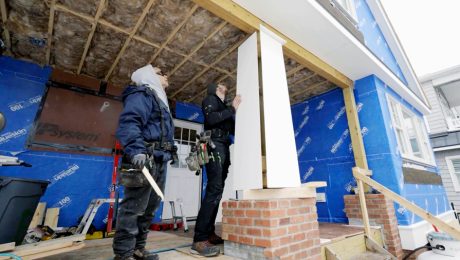
We recently rebuilt our home after a fire, and it currently has no exterior finish other than the housewrap. During the winter months and especially on the coldest days, I began to notice a dark moisture line on the back of the housewrap. This moisture line occurs at the joints in the exterior sheathing between the first and second floors. I suspect that the insulation and vapor barrier were done poorly between the floors, and warm, moist air leaked to the exterior and condensed behind the housewrap. I have been advised to cover the exterior sheathing with 3/4-in. foil-faced foam board, then add 1×3 strapping to provide an airspace behind, and nailing for, the siding. Is this fix sufficient? I want to make sure there is no moisture buildup after I put on the finished siding.
Chris Collier, Burlington, None
A:
Bruce Harley, a weatherization expert in Vermont and author of Build Like a Pro: Insulate and Weatherize (The Taunton Press, 2002), replies: You’re right, there seems to be enough warm, moist air getting into the band-joist area to support condensation on the back of even the highly vapor-permeable housewrap. If that is the only place with condensation, you probably would be fine with a small airspace behind the siding because the moisture could dry easily through the wrap. However, the inside surface of the sheathing is practically as cold as the wrap, so you probably also have condensation there as well. Once water condenses from vapor to liquid inside a framing cavity, it’s hard to dry it out. Rot and mold can follow.
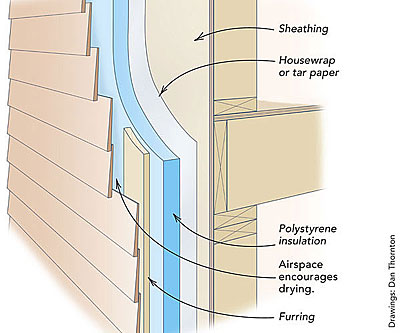
Covering the housewrap with rigid-foam insulation will warm the sheathing and reduce the condensation potential. I would suggest at least 1 in. (2 in. would be better) of polystyrene insulation, which will allow more drying to the exterior than foil-faced foam. The rigid foam also will dramatically improve the thermal performance of the rest of the walls because it forms a thermal break across the heatconducting studs, cutting your heating bill and reducing potentially damaging condensation throughout the house. The 1×3 strapping that you suggest will do a fine job holding the foam in place and acting as a nail base for the siding.