Q:
I keep hearing talk touting spray-foam insulation as a “superior” insulation material. I’ve been building for nearly 20 years, however, and I’ve occasionally found spray foam that has settled in the wall cavity and/or disintegrated enough to lose all of its effectiveness.
Mike Connors, Beacon, NY
A:
Bruce Harley, author of Build Like a Pro: Insulate and Weatherize (The Taunton Press, 2002), replies: Let me start by saying that the failed foam you’re describing is likely urea-formaldehyde foam insulation (UFFI). It was installed in many homes in the 1970s, often in retrofits, but eventually was banned in both Canada and the United States due to concerns about chemical off-gassing. The off-gassing problem, however, apparently resulted only occasionally due to improper mixing and application. Aside from the potential for off-gassing, though, urea-formaldehyde insulation also tended to become brittle, shrink, and crumble over time as a consequence of its chemical makeup, affecting durability and performance.
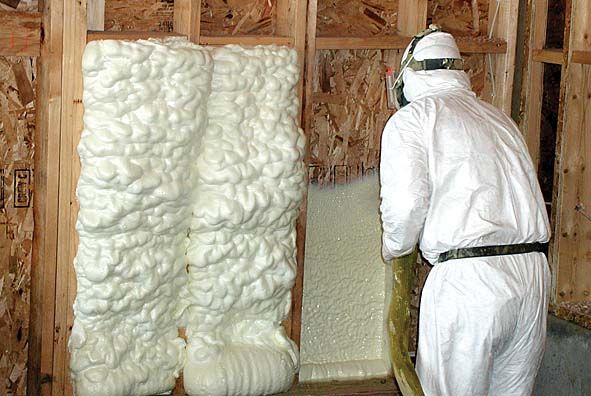
The current generation of spray-polyurethane foams is based on a different chemistry, making the cured foam much more chemically inert (and stable). This quality suggests that spray-polyurethane foams will last much longer than UFFI and retain their flexibility and mechanical integrity more reliably.
Spray-polyurethane foams have a 30-plus-year track record in commercial low-slope roofs, one of the harshest environments in the building industry. Studies on commercial roofs have found that spray-polyurethane foams age well, even in extreme heat and moisture. They retain their physical properties well, absorb little moisture (0% to 2%), and require recoating with ultraviolet (UV) protection every 10 to 15 years to remain sustainable for the long term. Fortunately, when they are used as home insulation, spray foams are most often installed in a wall or roof cavity, so UV-degradation is not a big concern. Compared to commercial roofs, residential applications also see far less exposure to extreme heat or moisture, the two biggest drivers of material degradation.
The bottom line is that I wouldn’t worry about the durability of the foams that are currently available. In fact, I believe that in some applications, today’s spray foams add to the durability of the overall structure by reducing air leakage and vapor diffusion.