Fixing warped cabinet doors
Q:
I sometimes receive warped factory-built cabinet doors. Will clamping them to an overcorrected state relieve warping? Is there another way to straighten them?
Curtis Vick, Ceres, CA
A:
Rex Alexander, a cabinetmaker from Brethren, Michigan, replies: I’m assuming that by factory-built, you are referring to a frame-and-panel door, and that the warping you are talking about is a twist in the door. This type of twist would cause a cabinet door, when shut, not to meet the face frame at the top or bottom. I’ve never been able to remove a twist from a door by clamping it to an overcorrected state. In most cases, though, a simple hinge adjustment can correct this problem, disguising the twist by compensating for it on the hinge side of the door.
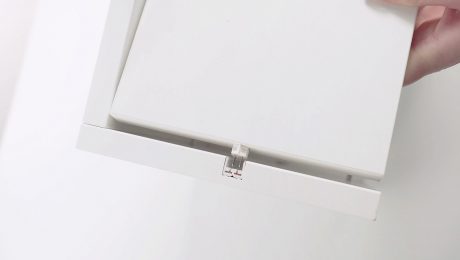
The most common factory hinges are cup hinges, which are mortised into the cabinet door. This type of hinge is also the most versatile, with multidirectional adjustment made by simply turning a cam in or out with a Phillips screwdriver.
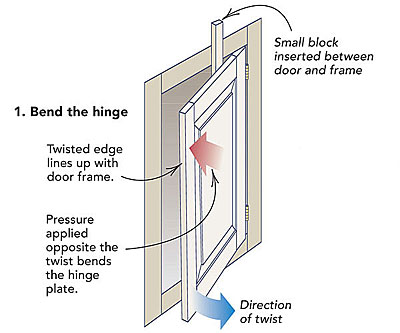
Surface-mounted hinges are a little trickier to adjust. I open the door and put a 1x block of wood between the door and the face frame opposite the twist. Holding the block in place as a fulcrum, I quickly move the door closed (or as close to closed as I can get), which bends the plate that mounts the hinge to the door. This bend kicks the hinge out and the twisted edge in at the same time.
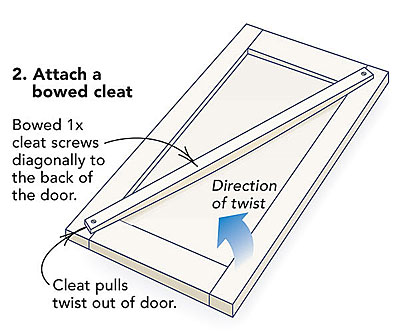
If it’s a worst-case scenario or if you’re dead set on physically taking the twist out of the door, my only suggestion is to install a permanent cleat cut in a bow shape diagonally across the back side of the door. The bow in the cleat should have enough tension to correct the twist in the door. The dimensions of the cleat will vary depending on the type of wood the door is made of and the severity of the twist. To correct an extreme twist, a hardwood cleat with a more pronounced bow may be necessary.