
Flashing on a Curve
With modern flashing tapes, a metal head flashing isn't needed on an arched window—but there are ways to make one if you want to.
Q:
I need to install a curvetop vinyl window. What is the best way to flash the window at the top?
Bob Hazard, Newhall, CA
A:
Editorial adviser, Mike Guertin, responds: The approach I take depends on whether the window is flanged, whether it has additional casing around it, or whether the head has to be flashed with metal (for architectural reasons or personal preference).
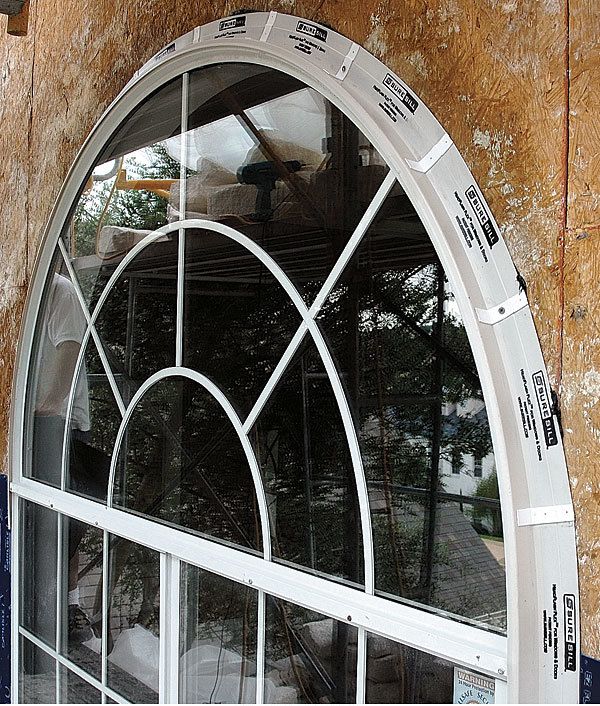
Most flanged curve-top windows can be flashed with flexible self-adhering tape without an additional flashing.
Curved windows without a flange or flanged windows with a separate casing need flashing. I like to use flexible Z-flashings. Some have wall legs that are notched; they need additional steps to make them watertight. Other flexible flashings, like SureSill’s HeadFlash-Flex (www.suresill.com) and Astro Plastics’ Astro Flashing (www.astroplastics.com) have wall legs that fan out to the wall. There are nuances to installing flexible flashings, and manufacturers’ instructions will help you there. Don’t apply asphalt-based selfadhering flashing tape over the wall leg of flexible flashings unless the manufacturer approves it. The asphalt can react with additives that make the plastic flashing flexible. Instead, use a butyl-based selfadhering flashing tape.
Finally, you have a few options for curved metal cap flashings. If roll lead flashing is available in your area, hammer-form it to match the curve of a window head. Rather than using the window head as a form, cut a duplicate circular segment from a piece of plywood or OSB. Stack a couple of sheets to reach the same depth that the window frame or head trim projects from the wall surface. Hammer-form the lead using a block of hardwood to spread the blows to a larger area and to minimize cracking the lead.
When I have a batch of windows to flash with metal and the designer doesn’t want lead, I make a template of the curve from a piece of cardboard and have a local metal shop fabricate pieces from copper, bronze, or stainless steel.
For one window, I make my own flashing from copper or lead-coated copper. First, bend the flashing on a sheet-metal brake for the desired drip-leg, cap, and wall-leg dimensions. Make a plywood or OSB form to match the window-head curve. Snip a series of equally spaced cuts in the wall leg, closer together for short-radius curves and farther apart for long-radius curves. Bend the metal flashing around the form, and clamp it so that the wall-leg sections lie flat against the backing sheet. Cut V-shaped cards that are about an inch larger than the notch voids that are left at the wall-leg cuts. Make 90° bends about 1⁄2 in. in from the tip of the V-cards, and center a card over each notch void. Clamp the cards and flashing to the backing sheet; any warp in the wall leg will prevent the flashing from lying flat to the wall or the head of the window. Solder the V-cards to the flashing, and buff the finished product before installing.
