previous
  • Complete Kitchen and Bath Guide
    Complete Kitchen and Bath Guide
  • Buyer's Guide to Decking
    Buyer's Guide to Decking
  • Guide to Paperless Drywall
    Guide to Paperless Drywall
  • Outdoor Kitchen Design Inspiration
    Outdoor Kitchen Design Inspiration
  • 12 Remodeling Secrets Revealed
    12 Remodeling Secrets Revealed
  • Painting Ideas, Tips, and Techniques for a Professional Finish
    Painting Ideas, Tips, and Techniques for a Professional Finish
  • Meet the Fine Homebuilding Project House!
    Meet the Fine Homebuilding Project House!
  • 13 Door Design and Installation Tips
    13 Door Design and Installation Tips
  • The Inspector Game: Decking Dos and Don'ts
    The Inspector Game: Decking Dos and Don'ts
  • Fine Homebuilding: The Digital Issues
    Fine Homebuilding: The Digital Issues
  • 15 Coffered Ceiling Design Ideas and Tips
    15 Coffered Ceiling Design Ideas and Tips
  • 7 Solutions for Kitchen Layout and Design
    7 Solutions for Kitchen Layout and Design
  • Deck Design & Construction Showcase
    Deck Design & Construction Showcase
  • 9 Design Ideas & Tips for Concrete Countertops
    9 Design Ideas & Tips for Concrete Countertops
  • Roofing articles, videos, tools, and materials
    Roofing articles, videos, tools, and materials
  • 2012 HOUSES Awards
    2012 HOUSES Awards
  • Energy-Smart Details
    Energy-Smart Details
  • 7 Small Bathroom Floorplan Layouts
    7 Small Bathroom Floorplan Layouts
  • 10 Basement-Remodeling Tips and Techniques
    10 Basement-Remodeling Tips and Techniques
  • How it Works
    How it Works
next

Save water with a home run

Q:

I plan to use PEX tubing throughout the house I’m building. Someone told me that compared to a traditional trunk-and-branch system, a home-run system with manifolds will save water and energy.


As far as I can tell, the distance hot water has to travel from the tank to a faucet or appliance is virtually the same in both systems. How does a home-run system save water and energy?


Rob Jones, via email


A:

Georg Efird, owner of A2Z Plumbing Inc. ( www.eatsleepplumb.com ) in Asheville, N.C., replies: First, let me recap the difference between the two systems. A trunk-and-branch system consists of several branch lines (usually 1/2 in. dia.) that run off a main trunk line (usually 3/4 in. dia.). A home-run manifold system consists of uninterrupted lines that run directly from a manifold to each fixture in a house.
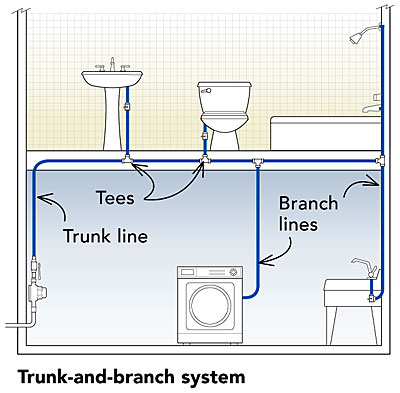
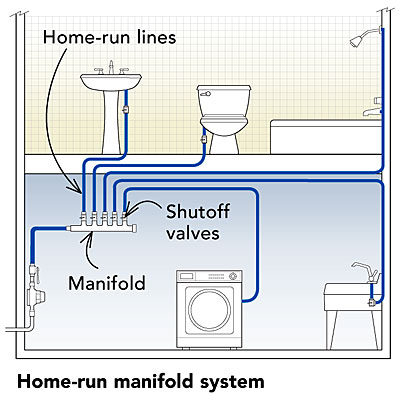


The main water-saving benefit of a home-run system is that there is less tepid water to purge in hot-water lines. If you’re not purging as much tepid water, you’re also improving the hot-water delivery time, which in turn saves energy.


How is it possible that there's less water to purge? The simple fact is, the smaller lines in a home-run system carry less water. As an example, consider that a 3/4-in.-dia. line carries nearly twice the volume of water as a 1/2-in.-dia. line of the same length. Although water is traveling the same distance in both systems, less water is actually traveling through a home-run line than through the trunk or branch lines.

No matter which system you use, fittings create friction, and friction negatively impacts water pressure. Because there are so few fittings in a home-run system, home-run lines can be smaller than branch lines—as small as 3/8 in. dia.—without negatively impacting water pressure.
From Fine Homebuilding 196, pp. 92 May 14, 2008