
Q:
I’m planning a small shed-roofed addition that will tie into my house’s gable roof just above the eave. The rafter tails will be exposed with no soffit. I’m considering a flat ceiling, with insulation batts between the ceiling joists and a vapor barrier. Would it be better to insulate between the rafters with extruded polystyrene? What about ventilation?
Tim Olsen, SD
A:
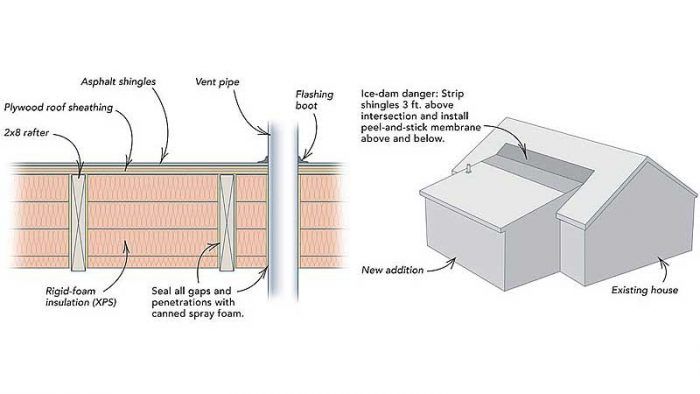
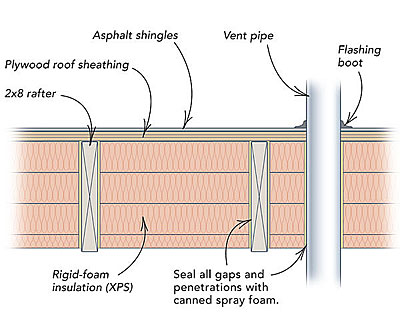
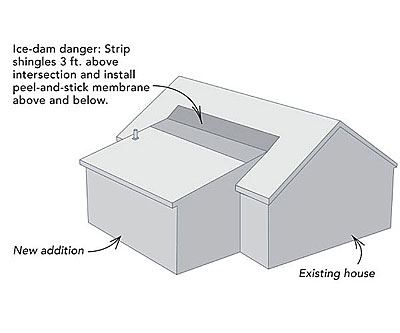
Bruce Harley, an engineer and the author of Build Like a Pro: Insulate and Weatherize , replies: Venting a shed roof is a tricky proposition, and its necessity is debatable in a cold climate like yours. But there are a couple of effective options for unvented cathedral ceilings. The simplest is one you suggested: Fill the rafter cavity with successive layers of extruded polystyrene (XPS) that also will stop air movement and act as a vapor retarder. Be sure to seal each piece of insulation (at all sides) to the framing and to seal any penetrations (wiring, vent pipe, etc.) with canned spray foam or caulk. Pay extra attention to sealing the XPS to the top plate of the new and old eave walls. With a small job, it won’t drive you nuts to be a detail fanatic. That’s the short answer, but I see a red flag where the low-slope roof meets the steep roof: It’s an ice dam begging to happen. In terms of heat loss, your house is probably leakier than your addition will be, and the heat loss may melt snow that will run down and refreeze when it hits the new roof. When shingling the new roof, strip off 3 ft. of shingles above where the roofs meet, and install peel-and-stick rubberized roofing membrane on both the new and old roofs. This will help to prevent the effects of ice dams, but insulating and sealing the existing attic can help to prevent the actual ice dams.
 |
 |
From Fine Homebuilding #169
