Q:
I live in an old house and want to install outlets in the baseboards of a second-floor bedroom that has no power. I already ran a 20-amp home run from the electrical panel to one corner of the room, but I can’t run wires through two of the stud walls because they’re infilled with brick. Can I run armor-clad (AC) wire behind the baseboard and staple it to the face of the studs?
Tom Strianese, via email, None
A:
Brian Walo, a licensed electrician in Mount Pleasant, S.C., replies: Running AC or nonmetal clad (NMC) cable behind the baseboards is fine provided that the “protection from physical damage” requirement outlined in Article 300.4 of the National Electrical Code (NEC) is followed explicitly. Essentially, the section states that for an application such as this one, you must eliminate the possibility that an errant nail or screw will hit the cable while you’re reinstalling baseboard or other finish material.
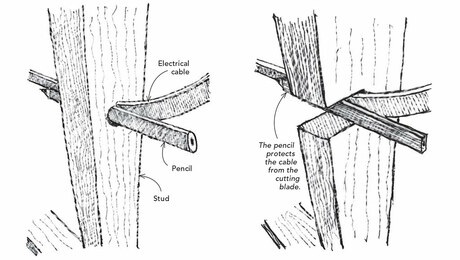
Although AC cable is approved for exposed work, where it won’t be subject to physical damage, the shielding on AC cable does not provide sufficient protection from nails when it is concealed in a wall or behind baseboard. Therefore, like NMC cable, if it’s within 11/4 in. of the finished surface, it must be protected by at least 1/16-in.-thick steel plating.
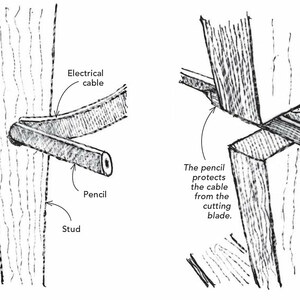
The simplest approach in the walls that aren’t brick-filled is to remove the baseboard and drill holes through the studs as you normally would. It’s also possible to notch the studs as long as you comply with local code requirements. Whether you drill holes or notch studs, you need to install an approved nail plate over each location where the cable passes through the studs within 11/4 in. of the finished surface.
For brick walls, I’ve often used rigid wire mold, which remains exposed and feeds specially designed outlet boxes that are left exposed as well. If you’re set on keeping the cable behind the baseboard, your options are limited. You could attach the cable to the studs, then fur them to clear the cable. If you do that, make sure to size the furring so that the finished face of the baseboard will be at least 11/4 in. from the cable. Otherwise, you need to conceal it within metal conduit.