Q:
What is the best way to place foundation anchor bolts in precise locations in a concrete foundation wall?
Scott Mathews, via e-mail, None
A:
John Spier, a custom-home builder on Block Island, Rhode Island, replies: In the midst of a concrete pour, it’s tough to care about the precise location of the anchor bolts. Consequently, the anchor bolts often end up all over the place: too high, too low, too far in or out, often under the joists or studs. If you’re lucky, the bolts end up meeting code for placement and embedment. The key to locating bolts precisely is to do it before the pour begins.
I’ve used a number of methods to handle the placement of bolts. The old standby is a short length of 1x or 2x material with a hole in it. Put the bolt through the lumber, thread on a nut, and nail the board to the form. (I use this method often for locating bolts in slabs with 2x forms.)
This method of locating anchor bolts is fast and effective, but because the board is nailed to the tops of the forms, the method works best if the forms are being filled close to the top. Although this system is more precise than simply pushing bolts into setting concrete, which technically doesn’t meet code, it’s still not the most accurate way to proceed.
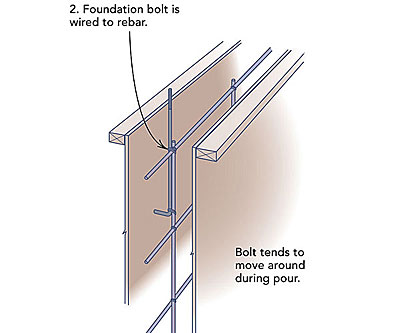
Another common approach is wiring foundation bolts to rebar. I try to wire bolts to vertical pieces of rebar, if possible. This technique sets the height right, but the bolts still tend to flop around during the pour and have to be straightened before the concrete sets up.
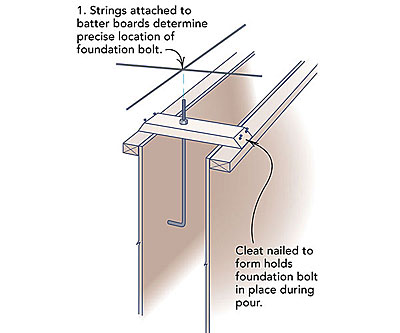
When bolt placement must be more accurate than the formwork itself, as when mounting hold-down hardware or column bases, I often set up batter boards and strings to determine exact bolt placement. Simple wooden cleats then hold the bolts in place for the pour.
Another neat method that I’ve used on smaller projects is to precut and drill the sill plates before the concrete pour. I mount the anchor bolts in the plates and drop the finished assemblies onto the wet concrete. The result is perfect placement, easy leveling and finishing, no voids or sill seal, and a lot of time saved.
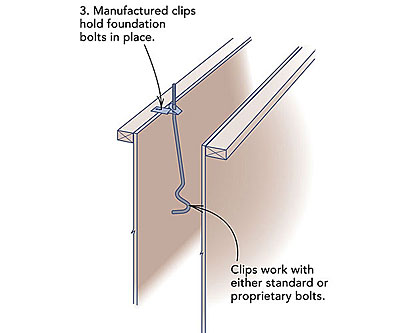
Finally, Simpson Strong-Tie (800-999- 5099; www.strongtie.com) makes a device called the MKP Monkey Paw Anchor Bolt Holder. These devices are reusable clips that are nailed to the forms and hold foundation bolts at a precise location and angle. They are designed for the big Simpson SSTB engineered hold-down bolts, but I’ve used MKPs for other types of bolts as well.












View Comments
I like using cleats, as shown in drawing 1. But then I place the sill on top of the cleats and drill pilot holes down through the sill into the cleats. I then can drill these holes out to the diameter of the sill bolts. I remove the sill for the pour and after the concrete sets the bolts will then be perfectly aligned to the sill. Make sure that the bolts don't get pushed out of plumb during the pour.