Q:
We recently had a roof replaced, and when there is any wind, the shingles stand straight up. We have lost many and are having trouble getting the roof fixed properly. Should the nails be above or below the tar line?
Robert Anderson, via email, None
A:
Stephen Hazlett, president of Hazlett Roofing & Renovation Ltd. in Akron, Ohio, replies: If the roof was replaced recently, the problem may have less to do with nail placement and more to do with roof temperature. Shingles installed in the fall, winter, or early spring may not heat up enough to activate the seal-down strip properly. Shingles installed in cold weather may have dust, dirt, leaves, and debris accumulating under the tabs and on the seal-down strips for months and may never seal properly (particularly on the north side of roofs) even after warm weather arrives. My company generally confines roof replacement to mid-March through mid-October to allow shingles to seal down during warm weather. April and May are extremely busy months for us as we serve our customers who have been waiting patiently since November for a proper roof installation.
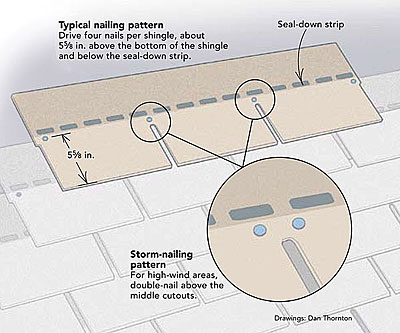
But nail placement is still important (see 10 Roof Goofs and How to Fix Them). Nail placement varies slightly among brands and styles of shingles. Usually, nails should be placed about 5-5/8 in. above the bottom edge of the shingle and below the seal-down strip. Unfortunately, the placement of the seal-down strip by the manufacturer varies quite a bit, sometimes making it nearly impossible to place nails both 5-5/8 in. above the bottom of the shingle and below the sealdown strip. Keep in mind that the nails should hit both the shingle being installed (as a primary fastener) and also the top 1 in. to 2 in. of the underlying shingle (as a secondary fastener).
For high-wind areas or on roofs steeper than 10-in-12 pitch, I storm-nail shingles—that is, I double-nail the two middle cutouts.