Q:
We are planning to build an addition to our house, and the design of the addition is such that the only practical way to run the ceiling joists is perpendicular to the rafters. Installation of the rafter ties will negate any use of this space for storage. Is there some way of making the addition structurally sound while creating useful storage space in the attic?
Jake O’Brien, New Milford, CT
A:
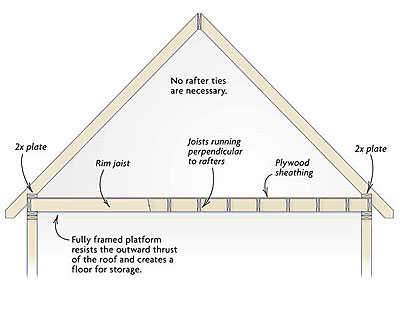
Mike Guertin, a contributing editor to Fine Homebuilding, replies: When the ceiling joists run perpendicular to the rafters and when you don’t want to have the rafter ties interfering with the attic floor, your best bet is to treat the ceiling joists as an attic-floor system.
After you have framed the walls of the addition in the regular way, install the ceiling joists with a rim joist running around the entire perimeter. Next, glue and nail the sheathing over the entire joist deck. Before you install the rafters, nail a 2x plate along the edges of the deck. The heels of the rafters are then cut to sit on the plates. This system is structurally stronger than the standard arrangement involving rafter ties and ceiling joists, and the system should give you a strong-enough floor to accommodate most light storage in the attic.






















View Comments
What would be the nail pattern at the heel to resist thrust