Q:
I’ve heard of loop systems that keep hot water at the faucet at all times, meaning that you don’t have to dump gallons of water down the drain waiting for the water to warm up. Can you explain how this type of system works, and can you furnish a schematic of the system?
J. E. Houchin, Lone Oak, TX
A:
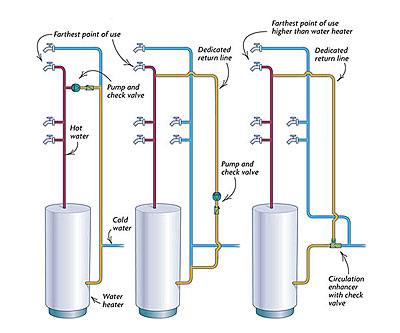
Mark Eatherton, a plumbing and heating contractor in Denver, Colorado, replies: With a typical home plumbing system, the hot water in the supply pipe begins to cool down as soon as the faucet is shut. A hotwater loop keeps heated water close to the faucet at all times by circulating cooled water back to the water heater to be reheated.
There are three basic ways to create a hot-water loop. The first and simplest method is installing a small pump on the hot-water line at the point of use farthest from the water heater, usually a bathroom sink or shower. The discharge on the pump is connected to a check valve, which keeps cold water from running back into the hot-water line, and then to the cold-water line.
During the early-morning hours or whenever hot water is most often used, a timer starts the pump, and the pump draws hot water from the tank through the hot-water line to the farthest point of use. The cooled water that is pumped into the cold-water line pushes water back into the tank for reheating.
When hot water reaches the farthest point of use, a temperature-sensitive switch shuts off the pump. Although this system works well, you do end up with some warm water in cold-water lines when the pump has been running.
The next two scenarios circulate hot water back to the water heater via a dedicated return line from the farthest point of use. In one example, a small pump is installed on the return line before it connects to the cold-water inlet at the water heater.With this setup, the small pump can be controlled by a timer or a temperature-sensitive switch or both. Again, the pump must be connected to a check valve so that cooled water cannot be drawn back into the system when the hot water is running.
The last scenario works only if the points of use are higher in elevation than the water heater. This system uses natural circulation or convection to move the water. In this situation, the hot water, which is less dense, rises in the hot-water supply line, and the colder, more dense water settles down the return line and goes back to the water heater. As in the other loops, a check valve keeps cold water from moving backward through the return line during a draw of hot water.
A natural convection hot-water loop can be enhanced by adding a circulation-return enhancer called Just Right, manufactured by Nibco (800-234-0227; www.nibco.com). This device consists of a venturi fitting and a special check valve. The venturi fitting causes a slight negative pressure on the branch of the enhancer where the circulation return line is connected.
The cooler water is then drawn down the return line and into the water heater, and hot water is forced to circulate through the hot-water main to its connection with the circulation return.
In all these scenarios, water is saved from running down the drain while waiting for the hot water to get to the tap. However, you can expect a slight increase in energy use to keep hot water available instantly, as well as for any extra electricity needed to run the pumps. I’d also recommend insulating the hot-water supply line, especially where the line passes through or near an unheated space.