Q:
We built a tight house and installed a heat-recovery ventilator (HRV) because of our concern about the fresh-air supply. However, the unit tends to whistle, even when it is run on the recommended low setting. When the outside temperature drops below 10°F, the machine starts bellowing in a cycle of 5 minutes on and 15 minutes off. The manual indicated that the bellowing was coming from the ventilator’s defrost cycle, which uses air from the basement. Are there any heat exchangers that use a different method of defrosting at low temperatures? How can we stop that annoying whistle?
Ursula Gibson, Etna, NH
A:
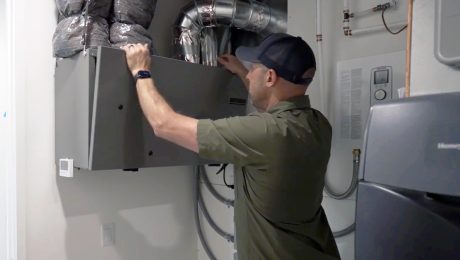
Russell A. Bertrand, president of Bertrand’s Refrigeration in Wakefield, Rhode Island, replies: Without seeing your installation, it’s difficult to diagnose the exact nature of the problem, but here are some suggestions. First, the whistle may be caused by undersize ductwork leading to and from the heat exchanger. An undersize duct increases the velocity of the air in the duct, creating a whistle or howl. There are several possible solutions, the easiest and least expensive of which is to wrap the ducts and the heat exchanger with 1-in. thick vinyl duct insulation. If the ducts are already wrapped, my second suggestion is to install an air-movement sound absorber, which is installed in the ductwork and acts like a muffler to cut down on noise. More-expensive options are installing larger-diameter ducts to lower the air velocity or replacing metal ducts with the flexible variety that don’t conduct sound. As a last resort, a fiberglass sound liner can be glued or pinned inside the ducts.
The second problem of the heat exchanger needing to defrost below 10°F is, unfortunately, the nature of this beast. However, I suggest putting in an electric heater to warm the incoming air and reduce the possibility of icing the heat exchanger in your recirculator.
Using air from the basement to defrost the heat exchanger in an extremely tight home such as yours is potentially dangerous. Negative pressure can be created in the house and cause the chimney draft to reverse (or backdraft), drawing poisonous and combustible flue gases into the living spaces of your home.
Research Products Corporation (608 257- 8801) of Madison, Wisconsin, makes the PerfectAire fresh-air exchanger, which the company claims does not need a defrost cycle. The folks at RPC said their cross-heat exchanger makes the defrosting of their unit unnecessary. (I won’t try to explain how a cross-heat exchanger works within the confines of this column.) Located in the chilly state of Wisconsin, RPC employees said they have been running their exchangers there for years without problems.