previous
  • Complete Kitchen and Bath Guide
    Complete Kitchen and Bath Guide
  • Buyer's Guide to Decking
    Buyer's Guide to Decking
  • Guide to Paperless Drywall
    Guide to Paperless Drywall
  • Outdoor Kitchen Design Inspiration
    Outdoor Kitchen Design Inspiration
  • 12 Remodeling Secrets Revealed
    12 Remodeling Secrets Revealed
  • Painting Ideas, Tips, and Techniques for a Professional Finish
    Painting Ideas, Tips, and Techniques for a Professional Finish
  • Meet the Fine Homebuilding Project House!
    Meet the Fine Homebuilding Project House!
  • 13 Door Design and Installation Tips
    13 Door Design and Installation Tips
  • The Inspector Game: Decking Dos and Don'ts
    The Inspector Game: Decking Dos and Don'ts
  • Fine Homebuilding: The Digital Issues
    Fine Homebuilding: The Digital Issues
  • 15 Coffered Ceiling Design Ideas and Tips
    15 Coffered Ceiling Design Ideas and Tips
  • 7 Solutions for Kitchen Layout and Design
    7 Solutions for Kitchen Layout and Design
  • Deck Design & Construction Showcase
    Deck Design & Construction Showcase
  • 9 Design Ideas & Tips for Concrete Countertops
    9 Design Ideas & Tips for Concrete Countertops
  • Roofing articles, videos, tools, and materials
    Roofing articles, videos, tools, and materials
  • 2012 HOUSES Awards
    2012 HOUSES Awards
  • Energy-Smart Details
    Energy-Smart Details
  • 7 Small Bathroom Floorplan Layouts
    7 Small Bathroom Floorplan Layouts
  • 10 Basement-Remodeling Tips and Techniques
    10 Basement-Remodeling Tips and Techniques
  • How it Works
    How it Works
next

How to Repair Hairline Cracks in Chimney Mortar

Q:

During a recent heavy rain, I noticed a steady drip near my fireplace. The drip indicates a leak somewhere around my chimney. I’m not sure if the water is getting in through mortar joints (some have hairline cracks) or through the brick. Is there a way to seal the brick and the cracks? I’ve ruled out all other entry points.


Mike Guertin, East Greenwich, RI


A:

Cody Macfie, owner of Steep Creek Stoneworks Inc. in Brevard, N.C., replies: In terms of water entry, the most-important part of a chimney is the flashing. If the flashing isn’t installed properly, sealing the brick and the mortar joints will be about as productive an endeavor as trying to have a conversation with a fish. If you’re sure the flashing is fine, though, and you have eliminated all other potential problem areas, sealing the brick and the mortar is inexpensive and easy.


To seal mortar cracks and brick, I use a waterproof sealant by Prosoco called Siloxane PD (www.prosoco.com; about $25 a gal., available at most masonry-supply stores). I don’t add water to the Siloxane PD, and I like to apply it with a garden sprayer so that I can spray it directly into the cracks. After all cracks have been filled, apply a couple of layers of Siloxane PD over the entire chimney to seal the brick.
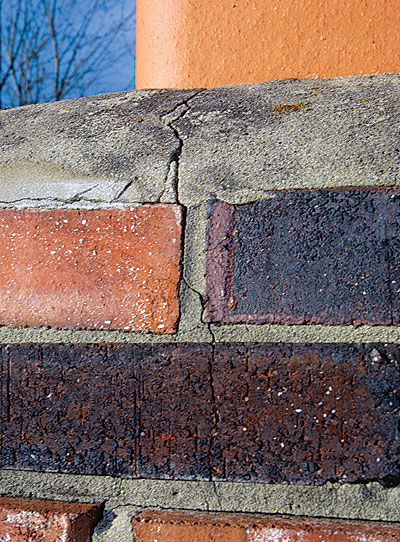

Seal the cracks before they’re too far gone. Hairline cracks in brick and mortar can be sealed. The larger cracks in this chimney cap should be repointed before penetrating sealant is applied.

Seal the cracks before they’re too far gone. Hairline cracks in brick and mortar can be sealed. The larger cracks in this chimney cap should be repointed before penetrating sealant is applied.

Photo by: Daniel S. Morrison
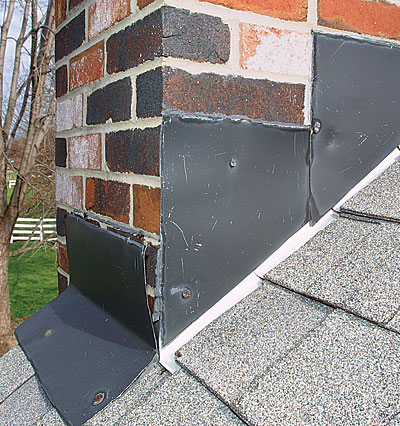
Inspect the flashing. Improperly installed flashing can cause major water damage. Unlike this application, flashing should tuck into the mortar joints and fold around the chimney’s corner

Inspect the flashing. Improperly installed flashing can cause major water damage. Unlike this application, flashing should tuck into the mortar joints and fold around the chimney’s corner

Photo by: Daniel S. Morrison
From Fine Homebuilding 196, pp. 90 May 14, 2008