
Retrofitting Footings When Digging in an Old Basement
An engineer offers design advice and words of caution for building concrete retaining walls after removing a basement slab.
Question:
I have an old house that’s been added on to many times. There are several basement areas, all with slab floors of different elevations. I am breaking up the basement slabs so that I can install concrete piers and lally columns to support the building. While I’m at it, I’ll install a drain around the inside of the foundation walls. Then I’ll place a new slab at one continuous level throughout the basement. The basement is fully below grade, and the soil is dense hardpan. But several of the foundation walls—some are 10-in. block, some are 12-in. thick poured concrete—do not rest on footings. Because I’m digging as much as 24 in. below the walls, can you suggest a way to hold the existing walls in place?
Rich Rybski, Southwick, MA
Christopher DeBlois, a structural engineer with Palmer Engineering in Chamblee, Georgia, replies: Though it may look like a recipe for trouble, the lack of footings under your basement walls is not necessarily a big deal. The weight on a typical basement wall, including the weight of the wall itself, is usually less than 2,000 lb. per linear ft. (plf). A standard (and usually conservative) allowable bearing stress for undisturbed soil like your hardpan is 2,500 lb. per sq. ft. (psf). As a result, the stress on the soil under your 12-in. thick walls is within the limits of the soil.
What, then, is the purpose of a concrete footing? There are at least three good reasons to place a wide, continuous footing under basement walls. First, the allowable soil stress in certain soils may be relatively low, and the actual weight on certain walls may be relatively high. In such a case, spreading the load over a larger area than just the width of the wall is crucial.
Second, soil properties can vary over short distances. A reinforced-concrete footing can help transfer loads across soft spots, particularly for block walls. Poured-concrete walls tend to act as deep beams to traverse soft spots with or without the help of a footing.
Third, footings provide a terrific base for masonry walls. The first course of block is supported much more evenly when it sits on a concrete footing than when it just bears directly on soil. If you’re pouring a concrete wall, it’s a whole lot easier to set formwork on a footing than on soil.
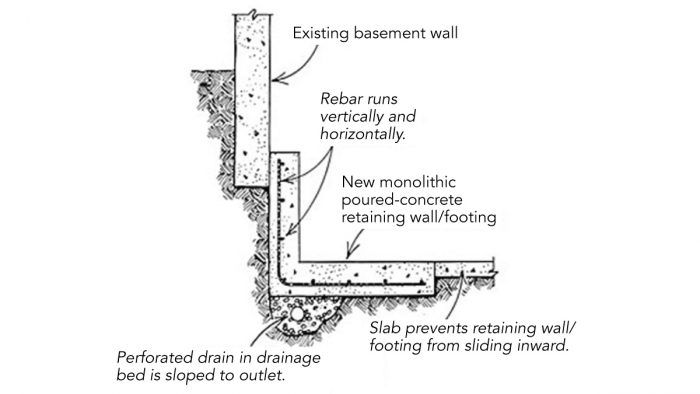
All that said, is it worthwhile to retrofit a footing to an existing basement wall? For a wall that has served well for 10 or 25 or 70 years, no. The potential pitfalls involved with undermining the wall before the footing goes in are far greater than any benefits the footing might provide. It is crucial, though, to provide support for the bottoms of the walls to keep them from moving in toward the basement and to confine the soil supporting the weight of the wall. So you’ll need some kind of retaining wall/footing to keep the existing walls in place. The illustration shows my design for building a monolithic, steel-reinforced concrete retaining wall/footing.
In designing this retaining wall, I checked six possible modes of failure: The wall portion cracks off at the footing, causing the wall either to fold over onto the footing or to slide forward across the footing; the footing portion pries off the face of the wall portion, again causing the wall to fold over or the footing to heave upward; the force from the basement wall shoves the retaining wall into the basement; and finally, the force from the basement wall rolls the retaining wall up and over the slab.
Without seeing the conditions of the site, I can’t give precise dimensions; consult an engineer for this information. Your contractor should take steps to shore up the disturbed soil and foundation before the retaining wall is placed.

View Comments
Thanks Christopher - good information. My question is: how the monolithic retaining wall/footer can be excavated in a sandy type soil without causing the soil under the foundation to cave in?
Nice post
Great post. keep sharing like this post!
To be clear, the original question raises two severe structural concerns.
1. Undermining the footing is implied. You should not be digging out soil within a 1:1 influence line of the bottom inside edge of those footings; meaning that if you were 12" from the inside face of wall, you should dig no more than 12" deep. You can underpin the footing to solve this problem.
2. You are laterally destabilizing the foundation. The foundation likely only retains soil adequately because it is braced at the bottom by the slab and soil. The slab must remain in place to satisfy the MA building code, which is IRC derived. The slab should not be removed. The bottom of the wall has the risk of sliding inward and collapsing.
One of the standard good moves here is to remove and repair in segments. A conservative approach would be to cut out a 4'-0" wide segment to the required depth every 12'-0" on center. Place the excavation spoils to either side of the excavation to help butress the existing wall, and at least tamp them compact. Once cut, cast any concrete required to extend the footings / wall vertically to contract with the new excavation depth. After that has fully set, do any additional work desired, such as installing the drainage trench, which may now lack a pipe due to sequencing considerations. Finally, cast a slab with adequate capacity to brace the wall in this scenario of increased pressure. I would recommend a 4" thick slab with WWF and a 8" thickness and width haunch at the perimeter, with pinned finished connection to the central slab, which must remain in place through the course of the initial underpinning. Once this has all been completed, you have stabilized the area at 1/3rd of the foundation (4' every 12'). The next step is to do the same thing again adjacent to the first stabilization (say to the left at every instance), completing 2/3rds. Then you do the last bit, getting your 3/3rds, and do anything else you needed to do.
If the soils and foundation were up to the task you could do 4' at 8' and only have two concrete placements, but i wouldn't trust the CMU wall or soil without information.