Q:
My 70-year-old balloon-frame house in Michigan has 4-in. walls with blown-in cellulose insulation. The redwood siding on these walls has deteriorated and must be replaced. After removing the old siding, can I wrap the unsided frame with a vapor barrier, clad the structure with two, 2-in. layers of rigid insulation and put up vinyl or aluminum siding? Books on renovation say this combination of materials will result in moisture buildup inside the walls. I don’t believe that moisture will condense if the R-value of the rigid insulation is high enough. What do you think?
James J. Miller, Chicago, IL
A:
Marc Rosenbaum, P. E., of Energysmiths in Meriden, New Hampshire, replies: The rule of thumb used by many who have built superinsulated double-wall houses is that at least two-thirds of the wall’s insulating value should be outside the vapor retarder. Your cellulose-insulated 2×4 wall might be about R-11, so you would be looking for at least R-22 on the exterior of any vapor retarder installed over the sheathing. This R-value would be provided by your 4 in. of extruded polystyrene insulation, which is also enough insulation to keep the wall-cavity temperature above the point where condensation would occur in all but the coldest weather.
What is more important for condensation control is to keep indoor air out of the wall cavity and to keep the indoor relative humidity under control in the winter. You’ll have to do a first-rate job sealing whatever vapor retarder or air barrier you install over the sheathing to keep indoor air from moving out through the wall and giving up moisture en route. If the house gets significantly more airtight in the renovation (as it should), then you may need to provide mechanical ventilation to keep humidity at reasonable wintertime levels of 30% to 40%
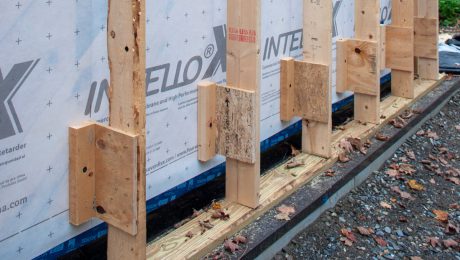
I would recommend that you install vertical furring strips over the foam, spiked through to the studs, and fasten the new siding to the furring strips. They will create a ventilation space behind the siding, so be sure to install screening at the bottom to keep the bugs out. The ventilation space might give you reason to consider installing wood siding: The space would allow wood siding to dry out more readily, therefore improving the performance of the paint and prolonging the life of the siding. An alternative wall finish that would go directly over the foam and eliminate the need for furring strips is synthetic stucco. It won’t rot, and you can get it with the color mixed in.











View Comments
I have seen this in several applications...if LP siding is going on the furring strips, do I need to be concerned about slippage between the two layers of rigid foam...seems like a lot two expect from a nail 4" from the wall to hold wood siding...have you experienced any of this?
Thanks,
Jeff