previous
  • Complete Kitchen and Bath Guide
    Complete Kitchen and Bath Guide
  • How it Works
    How it Works
  • Buyer's Guide to Decking
    Buyer's Guide to Decking
  • 13 Door Design and Installation Tips
    13 Door Design and Installation Tips
  • Guide to Paperless Drywall
    Guide to Paperless Drywall
  • Fine Homebuilding: The Digital Issues
    Fine Homebuilding: The Digital Issues
  • 7 Solutions for Kitchen Layout and Design
    7 Solutions for Kitchen Layout and Design
  • 12 Remodeling Secrets Revealed
    12 Remodeling Secrets Revealed
  • 7 Small Bathroom Floorplan Layouts
    7 Small Bathroom Floorplan Layouts
  • 15 Coffered Ceiling Design Ideas and Tips
    15 Coffered Ceiling Design Ideas and Tips
  • Painting Ideas, Tips, and Techniques for a Professional Finish
    Painting Ideas, Tips, and Techniques for a Professional Finish
  • 10 Basement-Remodeling Tips and Techniques
    10 Basement-Remodeling Tips and Techniques
  • Meet the Fine Homebuilding Project House!
    Meet the Fine Homebuilding Project House!
  • 2012 HOUSES Awards
    2012 HOUSES Awards
  • Outdoor Kitchen Design Inspiration
    Outdoor Kitchen Design Inspiration
  • 9 Design Ideas & Tips for Concrete Countertops
    9 Design Ideas & Tips for Concrete Countertops
  • The Inspector Game: Decking Dos and Don'ts
    The Inspector Game: Decking Dos and Don'ts
  • Energy-Smart Details
    Energy-Smart Details
  • Roofing articles, videos, tools, and materials
    Roofing articles, videos, tools, and materials
  • Deck Design & Construction Showcase
    Deck Design & Construction Showcase
next
Pin It

Secure deck boards where hidden fasteners can’t reach

Q: I’m building an ipé deck with a hidden-fastener system. From what I understand, I still need to screw through the face of the starter board and the end board. Is there any way to hide the fasteners?


Joshua Copp, via email


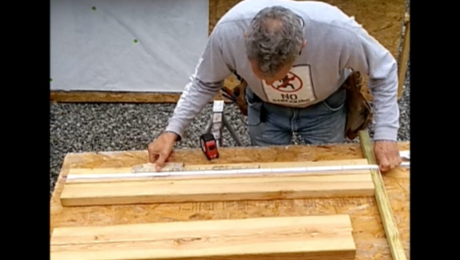
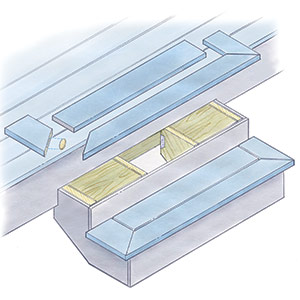
A: John Michael Davis, a carpenter in New Orleans, replies: I recently ran into the same situation. Hidden fasteners secure deck boards to joists from both edges of the board. Starter boards and end boards that abut a house or another structure, and boards that overhang the rim, can be fastened on only one edge, so you have to find some other way of securing the outer edge. The most common approach is to use screws and plugs. But I don’t want to fuss with those when I don’t have to, so I devised a system with clamps, biscuits, and glue (see “An Elegant Border for Your Deck”).

I did use stainless-steel screws and ipé plugs to attach boards where I couldn’t use clamps or biscuits, though (see my step-by-step process below). First, I drilled a hole for the screw, then a larger hole to set the head. I finished by gluing the plug in the hole. After the glue dried, I used a chisel to cut the plug even with the decking. EB-TY (www.ebty.com) sells screws and plugs specifically for starter and end boards.
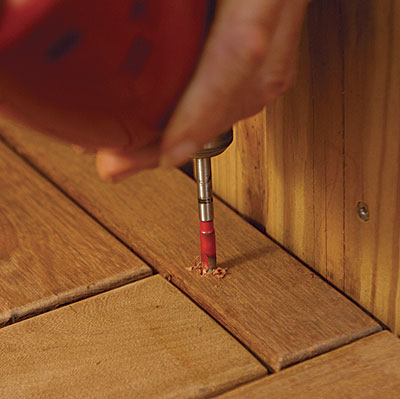
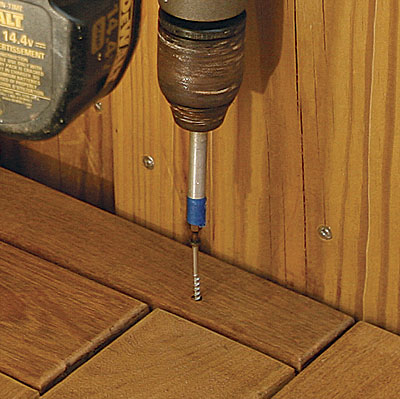
Drill through the decking with a bit size equal to the diameter of the screw's threads (in this case, 3.16 in.).Drill through the decking with a bit size equal to the diameter of the screw's threads (in this case, 3.16 in.). Photo by: Chris Ermides
Then, using a 3.8-in. Forstner bit, drill another hole deep enough so that the plug won't bottom out on the screw's head.Then, using a 3.8-in. Forstner bit, drill another hole deep enough so that the plug won't bottom out on the screw's head. Photo by: Chris Ermides
After driving the screw into the deck frame, glue the plug in place with Titebond III or epoxy, and tap it snug with a hammer. Finally, using a sharp chisel, knock off the top of the plug so that it is flush with the decking.After driving the screw into the deck frame, glue the plug in place with Titebond III or epoxy, and tap it snug with a hammer. Finally, using a sharp chisel, knock off the top of the plug so that it is flush with the decking. Photo by: Chris Ermides
From Fine Homebuilding 204, pp. 74 May 21, 2009