Q:
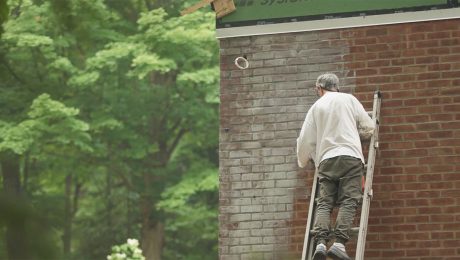
I’m repointing a single-flue brick chimney on the gable end of a roof. When I was just about at the top, I realized that the chimney had not been secured to the house. Does the chimney have to be anchored to the house, and if so, what is the proper procedure for doing that?
Brian Merrill, Sound Beach, NY
A:
Richard T. Kreh, author of Building with Masonry (The Taunton Press, 1998), replies: Tying a chimney to the wall of a house is kind of a conflict of interest. On one hand, code requires that there be a 1-in. airspace between the chimney and any combustible material, of which the side of the house certainly qualifies. On the other, you don’t want your chimney to fall over.
The vast majority of chimneys on outside gable walls of houses can be freestanding and don’t need to be supported, especially chimneys with multiple flues. However, single-flue chimneys, especially those in high-wind areas, should have some sort of added support. If the house is sided with brick, the chimney can be bonded directly to the brickwork. But if the house is sided with wood, different measures should be taken.
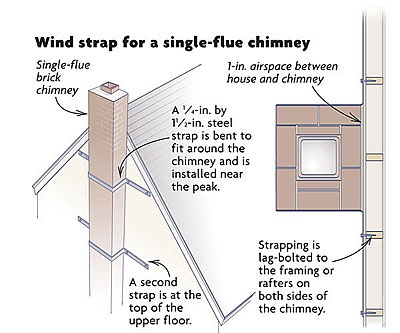
With an existing single-flue chimney on a house on the coast of Long Island, where you’re located, the quickest, easiest way to anchor the chimney is with U-shaped metal straps. These straps are made from 1/4-in. steel 1-1/2 in. wide and bent to fit around the perimeter of the chimney. I’ve had these straps made at a metal shop and prebent to the measurements of the chimney.
The straps extend to each side far enough that they can be lagged into the wall framing. To address aesthetics as well as to get the best possible connection to the house, you may want to run the straps behind the siding, especially with wood clapboards. Usually there is a strap at the top of the upper floor and another close to the peak of the gable. The peak strap can also be lagged to the gable rafter or barge rafter.
These straps are designed to help counteract horizontal movement of the chimney due to wind.They will not help with vertical movement from the chimney’s settling.
I discussed this issue with an engineer from the Brick Industry Association (703-620-0010; www.brickinfo.org), and he said that the BIA has no specific recommendations for attaching chimneys to houses in high-wind or seismic areas. Those requirements are handled by local building codes, so check with local code officials to make sure this solution satisfies local requirements.