Q:
A lot of homes in the coastal area of Cape Cod Bay were built with strange, inadequate roof systems. The steeply pitched roofs are insulated only with 1-in. foam over 1-1/2 in. matched pine nailed to heavy rafters 4 ft. o. c. The foam is covered directly with asphalt strip shingles without underlying felt. As a carpenter, I’ve repaired several of these roofs because although the roofs appear tight and undamaged, they invariably leak, usually where the roof meets a wall. As you might expect, these houses also use a lot of fuel during the heating season. Are these leaks actually evidence of condensation, and what is the best way to prevent condensation and improve the insulation value?
Karl Lekberg, Plymouth, MA
A:
Fred Lugano, a weatherization contractor in Vermont, replies: It doesn’t surprise me that you’ve seen problems with this type of roof. When a weak thermal envelope (ineffective insulation) is married to a deficient weather shell (no felt paper and questionable sealing and flashing) in a cold, wet climate such as yours, there is bound to be trouble. And the dynamics of those problems can change from hour to hour.
First, even with all the flashing installed correctly, shingled roofs need a secondary drainage system for reliable performance. Shingles cannot shed all the rain that’s thrown at them, so it’s vital that a layer of felt paper be properly installed under the shingles.
However, a leaky roof might be the least of your problems. Condensation could easily be the cause of the “leaks” in the houses you describe. To produce condensation, you need a big source of water vapor, a cold surface and passages connecting them. When I visit a house with mysterious ceiling damage in the winter, I always look downstairs first. A forcedair heating system coupled to a wet cellar or a central humidifier is really a condensation machine. With mechanical pressure, any tiny air leaks to the roof, such as the joints between the tongue-and-groove boards in the roof deck, can produce condensation.
The exterior foam sheathing could also be aggravating the situation. An inch of foam provides only R-5 to R-7 of insulation. That’s a pathetic conservation effort in New England, but it still should be enough to prevent a condensing surface if it is foil-faced and if the seams between the panels are sealed. Gaps in the insulation layer allow warm, moist air to flow into cold areas under the shingles where moisture condenses. In addition to gaps between foam panels, other discontinuities in the insulating layer, such as roof windows, can provide a cold trap for moist air.
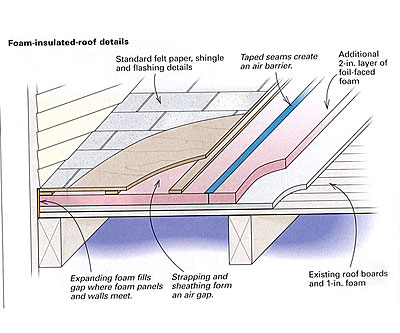
To upgrade the roof, I’d begin by tearing off the old roofing down to the foam. Air-seal the foam by taping the seams between the panels, and add an additional 2-in. layer of foam with those seams taped as well. Fill the gap where the foam panels meet an adjoining wall with expanding foam to seal that joint.
Next, I’d create an air gap on top of the foam by installing 1×3 strapping covered with a layer of CDX plywood. If you’ve completely air-sealed the roof plane, venting the space is not necessary. This air gap merely provides a temporary dumping ground for small amounts of moisture that may make it through the roof structure. Any moisture in the air gap gets quickly diffused through the plywood nail base. Make sure that there is a properly installed layer of felt paper under the new shingles and that the roof/wall connection is step-flashed correctly.
With the roof sound, now turn your attention inside to controlling the moisture load and the air pressure. Seal any possible roof penetrations such as the small triangular spaces left where V-jointed boards meet a wall or the gaps between the drywall and a beam. Sealing and balancing the return-air ductwork will reduce the air pressure in the house and throttle back accidental moisture flow. Disable all humidifiers, and damp-proof the foundation if necessary. The house interior will then stay comfortably humid with far less moisture input, and you’ll save energy as a bonus.