Q:
Maine summers are wonderful, but the upstairs of my Cape-style house is hot and stuffy. I run both bathroom fans (100 cfm) during the night to cool the house, but it’s not enough. To get more cool air into the house, I’ve considered boosting the bath fans to 150 cfm (or more) or installing an attic fan. Which is the better option? My roof is insulated with spray foam and the walls with fiberglass batts.
Scott Gibson, Steep Falls, ME
A:
Bruce Harley, author of Build Like a Pro — Insulate and Weatherize (The Taunton Press, 2004), replies: Hot and stuffy are really two different problems. Your solutions will involve cooling and fresh air.
Let’s start with fresh air. All homes need ventilation to deliver fresh air. The standard bathroom fan simply doesn’t cut it; you need continuous or nearly continuous operation to ensure good air quality, especially in a tight house (see Houses Need to Breathe … Right?, FHB #178, pp. 64-69). The best solution is a balanced ventilation system that supplies fresh air while removing stale air.
Bath fans and attic fans are exhaust-only systems. While exhaust-only systems help to improve air quality, they don’t draw air evenly from all points. Replacement air is governed by the stack effect (see the drawings). The result is as you’ve noticed: The upstairs is stuffy, and the downstairs is airy. The tricky part of the whole scenario is that the stack effect is reversed in the summer: Cool air sinks.
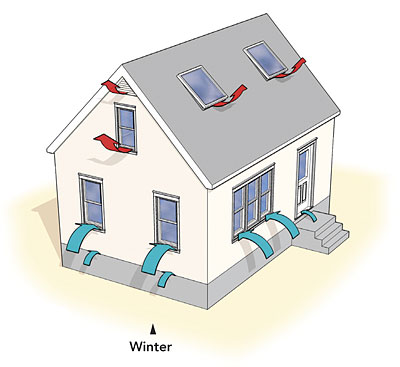
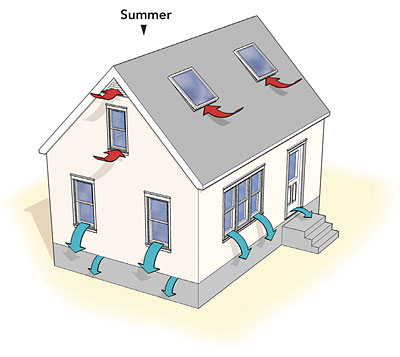
This brings us to your proposed passive-cooling strategy, which requires much more airflow than your bathroom fans provide. First, you need a powerful fan that can bring in air from all windows in the house; 500 to 1000 cfm is a much better target. Ideally, this would be a good-quality whole-house fan installed in the floor of a vented attic. Because your house is insulated along the rafters, that solution is a bit trickier. Your best bet is probably to consider a through-wall mounted fan (high on the gable at the end of an upstairs hallway, if possible) with louvers for the summer and a custom-made insulating box for the winter. The fan could be controlled by a timer, which would allow the fan to run for an hour or so, then turn it off automatically.
Run the fan in the evening when the air is cool. Keep it on long enough to cool down the house; you can balance how much air is exchanged by opening windows varying amounts. Run the fan again early in the morning. After the house is cool, close all the windows (shut and locked). Whenever possible, close shades or drapes, especially on the east and west sides to avoid solar-heat gain.
At my house, with the windows closed all day, the indoor temperature stays at least 10°F lower than the outdoor temperature. In late afternoon, the upstairs starts to get stuffy. This is when I open the windows. As the outdoor temperature starts to fall, the cycle repeats.

















View Comments
I think you should try Hover Fans. It is a good option for getting relief from summer.