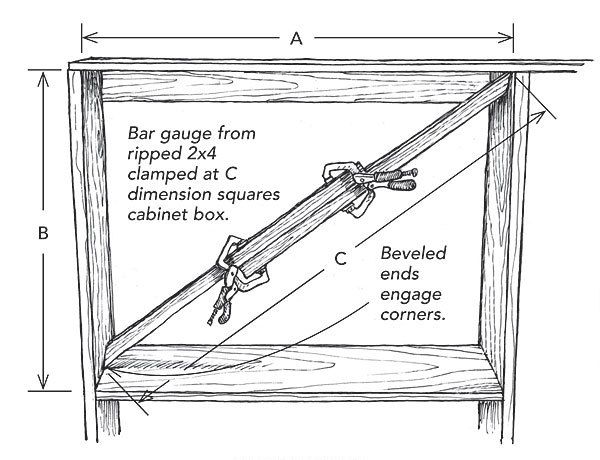
I work alone, so I often have to come up with jigs as extra “hands.” If I find my cabinet-opening diagonals aren’t equal, here’s what I do to square and hold them until permanent connections are in place.
As shown in the drawing below, I measure the adjoining sides A and B. Then I square each of these numbers and add them together. The root of this total is the diagonal C.
At the C dimension, I adjust and clamp a sturdy bar gauge made from a ripped 2×4. Then I rack the cabinet box until the gauge fits into what was the lesser diagonal. Now I’m ready to make my mechanical connections.
Michael Boothby, Langton, None
Edited and Illustrated by Charles Miller
From Fine Homebuilding #224













View Comments
I think you should say "square root" rather than just "root". It makes it more clear. Yes, I know I'm knit picking...Great tip though, thanks... John
Not to nit pick but it is nit picking, not knit picking.
I've been using this method for years, and never understood why the inaccurate measuring of diagonals with tapes was always the norm.
But... there is no need for any calculations (or the inaccuracies of measuring, the inaccuracies of converting fractional units to decimal, the rounding of decimal square roots and converting those decimals back to fractional units......).
Simply use the beveled diagonals in a "go/no go" fashion and rack the case until the adjusted diagonals fit snugly in both directions.
BTW, I would recommend using proper kiln dried cabinet wood, not construction 2 x 4's, for the diagonals.