While remodeling the basement of an older house, I ran into a shocking problem. The basement had been remodeled years ago. My job was to add a few sheets of drywall to the ceiling and to modify a wall. While I was mudding the seams between the old drywall and the new, I braced myself against a metal heater duct. As I pulled my joint-compound knife over the seam, it felt like I shoved a sliver into my hand.
I inspected the knife, and all it had was a gob of joint compound on it. No surprise there. So I went back to work, and the same thing happened. But as soon as I pulled my other hand off the heater duct, the bite went away. Hmmmm. Did I have a case of electric mud? I got out my circuit tester and probed between the duct and the wet joint compound. It read 107v. Wow!
Now what? It had to be a nail into a wire somewhere, and I was one coat short of a finished room. I checked with my electrician, and he confirmed my suspicion. It was imperative to find the short, even if it wasn’t in the work that I’d done. Here’s how I did it.
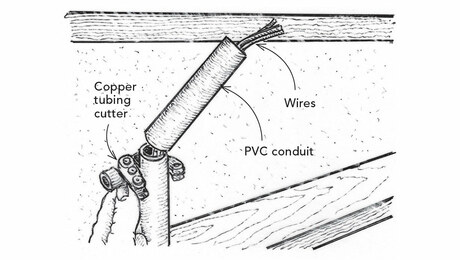
With a spray bottle full of saltwater, I moistened the mudded areas in the vicinity where I’d been shocked. I tested in all these areas until I got a 120v reading. I reasoned that this must be closest to the shorted area because the current would have the least resistance through the joint compound. I narrowed my target down to an area about 2-ft. sq. I carefully cut out this section and found an old 8d nail that the last guy had driven into the wiring. My electrician patched in a new piece of wire, and now I can sleep well at night.
David A. Siewert, Nehalem, OR