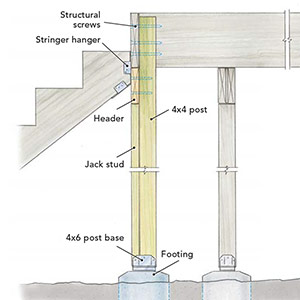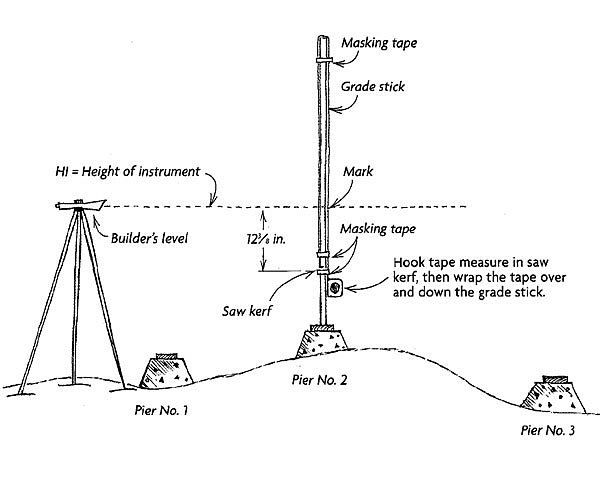
Whenever I build decks, I place the piers and then cut posts to carry the girders that will support the deck framing. The bottoms of the girders are in the same plane, but all the piers are at slightly different elevations. The problem becomes how to calculate the length of each post efficiently. As shown in the drawing, the method I’ve devised eliminates almost all the calculations. I simply read the length of each post off the scale on the grade stick. Here’s how my system works.
To start, calculate the height of a post needed for one of the piers, for example, pier No. 2. Suppose its post needs to be 12-3/8 in. from the top of the pier to the bottom of the girder. Have a helper hold a 1×2 grade stick atop the pier, and shoot it with a builder’s level. (Note: The grade stick must be long enough to shoot the lowest pier.) Mark your HI (height of instrument) on the grade stick and measure down 12-3/8 in. Now use a handsaw to make a 1/4-in. deep saw kerf at this line.
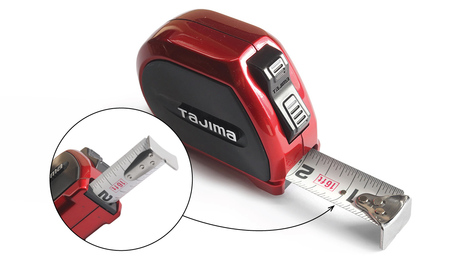
Insert the hook of a tape measure into the saw kerf, and wrap a piece of masking tape around the blade of the tape measure so that it’s secured to the grade stick. Now run the tape measure over the top of the grade stick and back down past the saw kerf. Lock the tape measure and wrap a couple more pieces of tape around the stick and the tapemeasure blade to hold things together.
Return to pier No. 2 and shoot the grade stick once again with the builder’s level. The cross hairs should line up with the 12-3/8-in. mark. You are now ready to shoot all the remaining piers. What you read in the level is the length of each post.
This may seem like a lot of trouble, but it goes more quickly than reading this tip. And you can apply the same method to all kinds of post and stud-length calculations.
Wil Gordon, Potter Valley, CA