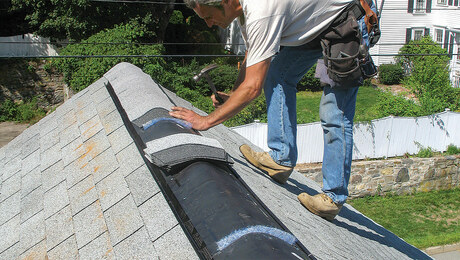
Slate roofs came into Ohio in the middle 1880s and fell out of favor about 1920. But they’ve never fallen out of favor with me. A lot of barns were topped with slates, and the chance to salvage the slates off a barn that was scheduled for dismantling led me to devise the sled shown in the drawing. The sled’s runners are 42 in. long, with easy curves on both ends. I made them out of 7/8-in. yellow poplar. The sled is designed to slide down a ladder, so I made the runners long enough always to bear on three ladder rungs at a time.
As shown in the right-hand part of the drawing, I butted a couple of 20-ft. ladders together and clamped them from below to create a 40-ft. long track for the sled. Its destination was the bed of my pickup, where my wife, Dawn, had the job of off-loading the slates. The truck isn’t exactly the safest place to be during the slate-lowering process. But this was back in 1979, when Dawn was a lot nimbler and able to bail out of the truck if the going got rough.
The slates on this barn were 14 in. by 24 in. and averaged 3/16 in. thick. I made stacks about 6 in. high, which is about the maximum load to fetch down at one time. A sled such as this one would also come in handy when retopping chimneys. Sometimes it’s not wise to throw the old bricks off the roof — a lesson I learned in Maine, back in 1949.
Clyde PL Kennedy, Rushville, OH