previous
  • Buyer's Guide to Decking
    Buyer's Guide to Decking
  • How it Works
    How it Works
  • Deck Design & Construction Showcase
    Deck Design & Construction Showcase
  • 12 Remodeling Secrets Revealed
    12 Remodeling Secrets Revealed
  • 13 Door Design and Installation Tips
    13 Door Design and Installation Tips
  • 15 Coffered Ceiling Design Ideas and Tips
    15 Coffered Ceiling Design Ideas and Tips
  • Outdoor Kitchen Design Inspiration
    Outdoor Kitchen Design Inspiration
  • The Inspector Game: Decking Dos and Don'ts
    The Inspector Game: Decking Dos and Don'ts
  • Painting Ideas, Tips, and Techniques for a Professional Finish
    Painting Ideas, Tips, and Techniques for a Professional Finish
  • 9 Design Ideas & Tips for Concrete Countertops
    9 Design Ideas & Tips for Concrete Countertops
  • Meet the Fine Homebuilding Project House!
    Meet the Fine Homebuilding Project House!
  • 2012 HOUSES Awards
    2012 HOUSES Awards
  • 10 Basement-Remodeling Tips and Techniques
    10 Basement-Remodeling Tips and Techniques
  • Energy-Smart Details
    Energy-Smart Details
  • Fine Homebuilding: The Digital Issues
    Fine Homebuilding: The Digital Issues
  • Guide to Paperless Drywall
    Guide to Paperless Drywall
  • Complete Kitchen and Bath Guide
    Complete Kitchen and Bath Guide
  • 7 Solutions for Kitchen Layout and Design
    7 Solutions for Kitchen Layout and Design
  • 7 Small Bathroom Floorplan Layouts
    7 Small Bathroom Floorplan Layouts
  • Roofing articles, videos, tools, and materials
    Roofing articles, videos, tools, and materials
next
Pin It

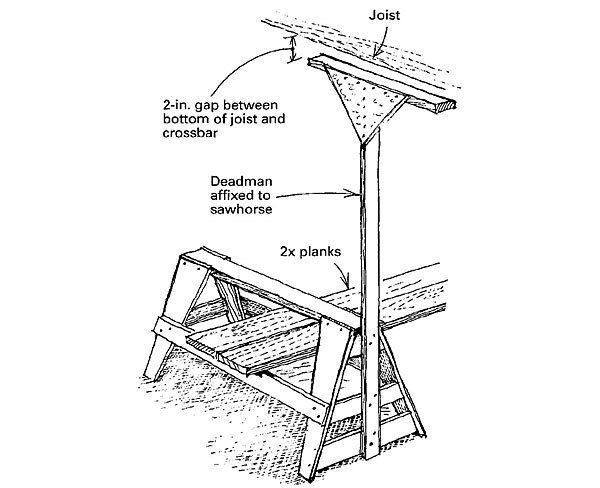
Sawhorse steadies drywall deadman

Putting drywall on a ceiling by yourself is never fun, but at least you can minimize the agony by using temporary supports (called deadmen) to steady the panels as you drive home the fasteners. The drawing illustrates how I combined the standard T-shaped drywall deadman with a sawhorse. I use a couple of these sawhorses to support a sheet of drywall.

The 2-in, gap between the top of the deadman crossbar and the bottom of the joists (or strapping) leaves enough space to slip the drywall easily into place. Then I place a 2x block between the crossbar and the drywall to lift the sheet into contact with the joists.

I stretch a couple of planks between the sawhorses for a mini-scaffold that allows an easy reach to the ceiling. A sturdy step stool beside the scaffold completes the setup.


Mike Hoffman, 108 Mile Ranch, British Columbia, ca
From Fine Homebuilding 92, pp. 30 January 1, 1995