previous
  • Buyer's Guide to Decking
    Buyer's Guide to Decking
  • 2012 HOUSES Awards
    2012 HOUSES Awards
  • 12 Remodeling Secrets Revealed
    12 Remodeling Secrets Revealed
  • Energy-Smart Details
    Energy-Smart Details
  • 13 Door Design and Installation Tips
    13 Door Design and Installation Tips
  • 7 Small Bathroom Floorplan Layouts
    7 Small Bathroom Floorplan Layouts
  • 15 Coffered Ceiling Design Ideas and Tips
    15 Coffered Ceiling Design Ideas and Tips
  • Meet the Fine Homebuilding Project House!
    Meet the Fine Homebuilding Project House!
  • Complete Kitchen and Bath Guide
    Complete Kitchen and Bath Guide
  • Roofing articles, videos, tools, and materials
    Roofing articles, videos, tools, and materials
  • How it Works
    How it Works
  • The Inspector Game: Decking Dos and Don'ts
    The Inspector Game: Decking Dos and Don'ts
  • Fine Homebuilding: The Digital Issues
    Fine Homebuilding: The Digital Issues
  • 7 Solutions for Kitchen Layout and Design
    7 Solutions for Kitchen Layout and Design
  • Outdoor Kitchen Design Inspiration
    Outdoor Kitchen Design Inspiration
  • 9 Design Ideas & Tips for Concrete Countertops
    9 Design Ideas & Tips for Concrete Countertops
  • Painting Ideas, Tips, and Techniques for a Professional Finish
    Painting Ideas, Tips, and Techniques for a Professional Finish
  • Deck Design & Construction Showcase
    Deck Design & Construction Showcase
  • 10 Basement-Remodeling Tips and Techniques
    10 Basement-Remodeling Tips and Techniques
  • Guide to Paperless Drywall
    Guide to Paperless Drywall
next
Pin It

Site-built peashooter

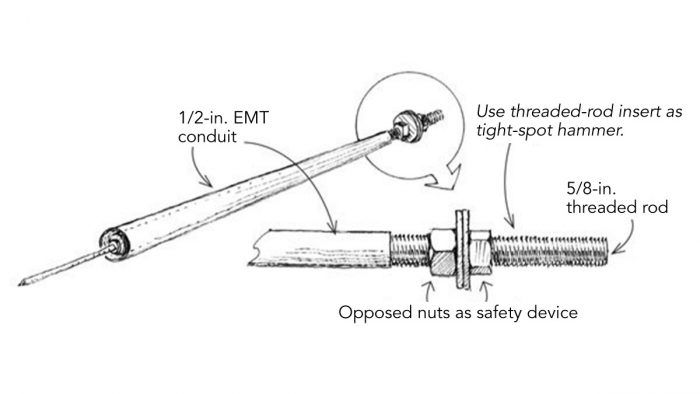
For tight-access nailing when you can’t even get a palm nailer into position, sometimes you have to go old school and use a peashooter. A peashooter is a hammer in a tube. The hammer is a rod with some heft to it, such as a steel stake. It fits inside a tube of slightly larger dimension. Place a nail in the tube, and use the rod to drive it home.

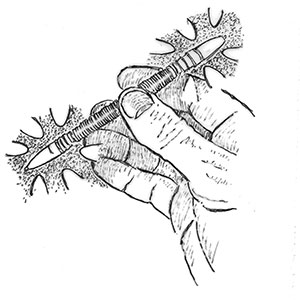
The drawing shows a version that can be assembled from materials typically found on job sites: a length of 5/8-in. threaded rod and a piece of 1/2-in. EMT metallic conduit (yes, due to the vagaries of nominal dimensions, a 5/8-in. threaded rod does fit inside a 1/2-in.-dia. tube). This arrangement will slam home 20d spikes with minimal effort. Other good fits are 1/2-in. threaded rod in 1/2-in. copper pipe or a foundation stake inside a piece of 3/4-in. PVC irrigation pipe.

For driving more than a few nails, adding some tape padding to the handle end is worthwhile. Likewise, the opposed nuts are not strictly required, but they can help you to avoid getting pinched. Trust me.


Gregg Roos, San Francisco, CA
From Fine Homebuilding 189, pp. 32 September 1, 2007