previous
  • Outdoor Kitchen Design Inspiration
    Outdoor Kitchen Design Inspiration
  • 7 Solutions for Kitchen Layout and Design
    7 Solutions for Kitchen Layout and Design
  • 10 Basement-Remodeling Tips and Techniques
    10 Basement-Remodeling Tips and Techniques
  • Energy-Smart Details
    Energy-Smart Details
  • 12 Remodeling Secrets Revealed
    12 Remodeling Secrets Revealed
  • Deck Design & Construction Showcase
    Deck Design & Construction Showcase
  • 9 Design Ideas & Tips for Concrete Countertops
    9 Design Ideas & Tips for Concrete Countertops
  • 15 Coffered Ceiling Design Ideas and Tips
    15 Coffered Ceiling Design Ideas and Tips
  • Complete Kitchen and Bath Guide
    Complete Kitchen and Bath Guide
  • Guide to Paperless Drywall
    Guide to Paperless Drywall
  • 2012 HOUSES Awards
    2012 HOUSES Awards
  • Fine Homebuilding: The Digital Issues
    Fine Homebuilding: The Digital Issues
  • Buyer's Guide to Decking
    Buyer's Guide to Decking
  • How it Works
    How it Works
  • Meet the Fine Homebuilding Project House!
    Meet the Fine Homebuilding Project House!
  • 13 Door Design and Installation Tips
    13 Door Design and Installation Tips
  • The Inspector Game: Decking Dos and Don'ts
    The Inspector Game: Decking Dos and Don'ts
  • 7 Small Bathroom Floorplan Layouts
    7 Small Bathroom Floorplan Layouts
  • Roofing articles, videos, tools, and materials
    Roofing articles, videos, tools, and materials
  • Painting Ideas, Tips, and Techniques for a Professional Finish
    Painting Ideas, Tips, and Techniques for a Professional Finish
next
Pin It

Tablesaw top extension

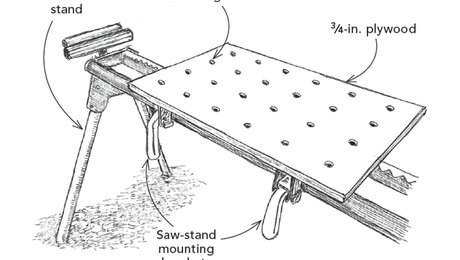
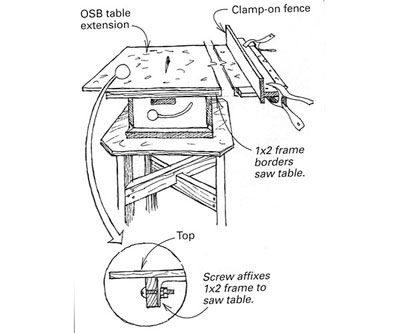
Every now and then, I have to use my portable tablesaw to cut wide, lightweight sheet goods, such as rigid-foam insulation. Trouble is, the saw's top isn't wide enough to accommodate sheet goods. As shown in the drawing, I made a temporary saw table that extends the work surface substantially on the right side of the blade.

The top is made of 1/2-in. oriented strand board (OSB). It's screwed and glued to a 1x2 frame that fits tightly around the saw's table. Most of the weight of the auxiliary table is on the right side of the saw. So to keep the OSB table from lifting, I bored a hole through the frame on the left side of the blade. A machine screw fits through this hole into a corresponding hole in the saw table, as shown in the inset drawing. A clamp-on fence made of 1x pine completes the rig. Now it's a cinch to cut 23-in. wide sheets of foam to vent a ceiling.


Robert Conrad, Pellston, MI
From Fine Homebuilding 112, pp. 32 November 1, 1997