Port-au-Prince 2.0
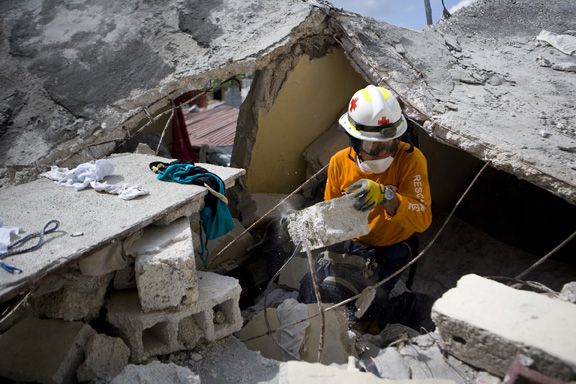
Many of you remember seeing this video from Simpson Strong-Tie. It shows a seven story wooden condo building undergoing a simulated earthquake of about the same magnitude that leveled Port-au-Prince the other day.
The primary reason it withstood the shaking is because it was flexible, unlike the majority of buildings in Haiti that were built of concrete. So my question is this:
When it comes time to rebuild Haiti (or the Chinese province of Sichuan, flattened in 2008), will the aid to rebuild come with strong recommendations to build in a manner that is not as susceptible to earthquakes? Let’s make the recent advances in building technology readily available to whoever is going to rebuild in these areas. It’s in all our best interests, right? Yes, there is no universal building code, and Haiti or China or Japan or California are all sovereign nations (well…) who should know best how to set their houses in order without advice from us. But sharing technology is a good thing, mostly. And how often do we have to repeat the same mistakes? Think of it like a vaccine that’s shipped around the world, except instead of preventing the flu, we’re preventing the loss of life and shelter.















View Comments
One as pect of rebuilding Haiti is that we have to remember that they haven't had a biqquake in 250 years, but the hurricane season comes every year. I did some work with a California architect who was doing a house in Florida and he told me that quakes and hurricanes presented lots of similar problems in terms of engineering, mainly designing and building in ways that resist lateral loads.
Wood-framed structures with liberal use of Simpson-type tiedowns will work pretty well during either event. Gotta be done right, and enforcement in a place like Haiti will not be easy.
Concrete structures properly engineered and reinforced will also perform, but there is a significant - VERY significant -problem getting properly mixed concrete. It's all to easy to skimp on the mix. Wood framed houses on the other hand - you can easily see whether all the parts are there or not.
I think this and other tradigies magnify the importance of having Codes that are followed and properly enforced.
Having worked with 3rd world countries helping them to develop construction and other vocational programs, I know that "Codes" as we know them can be economically devastating to them. They need to teach and learn appropriate "building practices and standards". This way there is not another government agent with his hand out looking for a bribe, the craftsmen just do it right to begin with.
I live just a few blocks from the epicenter of the 1994 Northridge earthquake (though I wasn't there at the time). Haiti had a quake about the same size as Northridge or Loma Prieta in 1989. In those quakes, dozens of people died, not hundreds of thousands. From this we can draw a conclusion:
Earthquakes don't kill people, buildings kill people.
So, yes, any aid should come with some kind of follow-through to make sure things are built right. Because of the corruption issue, it may require third party inspectors from first world countries. We certainly have enough qualified people here looking for work, they could be those boots on the ground.
-- J.S.
The big problems facing the rebuilding of Haiti even with proper building codes have already been mentioned; corrupt inspectors, the high cost of building to code in the Third World, and quality of materials. NGOs (non-government organizations) like Doctors Without Borders are able to provide medical care on tight budgets. A NGO focusing on construction/engineering would be able to provide properly engineered designs for the affected regions, materials, project management & supervision, and quality control/code enforcement needed to rebuild areas like Haiti that have been devastated by natural disasters.
I am pleased to see that no one, at least so far, has proposed a "light" building code. The ICC codes are already minimums by which to build, so making anything "lighter" is actually sub-code.
Also, sophisticated design, such as seismic resistant structures, generally require professionals. However, it should be easy to arrive at a manual of "parts", that, when assembled in any approved manner, will be code compliant.
Additionally, seismic design is no longer based on zones, as done back in the day. Instead, soil reports are required. Soil conditions can vary widely in a distance as short as 20 feet, so I could imagine the island perforated with boring holes from one end to the other. Such investigation also does not come cheaply, and requires time.
It would seem easy to just say to design to the worst condition for the whole island, but that may be extreme overkill and overly costly. It would likely pay to perform due dilligence.
With the great majority of the people of Haiti getting by on less than $2 a day just how many of those do you think can afford a quake or hurricane resistant house?
Best single dwelling going is wooden pallets roped together with a vinyl sheet roof... they won't even get that. Many people build their own home on land they don't own. They buy a few blocks at a time and start building.
I have a friend in Baja Mexico who's family built their 3 room 200sq ft... yes two hundred square feet... concrete block home over a four year time span; it was all they could afford to do .... and that's common in the POOR world.
One single Simpson tie down at $10 (exported to Haiti) is a week's food for an adult.
The scene in Haiti foretells the scene in Nepal once the, "100 Year Earthquake" hits here. Nepal, as Haiti, is very poor – among the poorest in the world. There are codes and blueprint requirements in metro centers like Kathmandu but in the village there are none. In the village, inherently, homes are spaced far apart; they won't collapse on each other. Contrarily the city sees multistory buildings built nearly on top of each other because land values are in the millions of dollars.
Before the concrete-diaphragm-sructure with brick-infill was imported from India, homes in Nepal were built the traditional way - the first floor masonry walls were at least two feet wide. The first floor height was between 5-6 feet (sic). The ratio was far less than 1:8. The Nepalese had learned from past earthquakes. As the walls progressed upwards they became thinner; the roof was a lightweight wood structure.
Then came the earthquake-interlude (there is a history of large earthquakes in Nepal) and everything Indian became popular including their building codes. But, you can't just import the codes, you need the knowledge behind it as well. Without that knowledge/understanding of why and the immportance of why, not even the builders will build correctly. As a result I see builders copying the Indian style of building that have no idea where, how much, or what size rebar to place in their concrete. They have no idea of concrete mixes, aggregate requirements, water requirements. The aggregate is full of clay that never gets washed out. They just wing everything because they know that "concrete is strong". I have seen rebar placed within a half inch of the outside of concrete collumns. I have seen flat concrete roofs that are only three inches thick reinforced with 1/2 inch rebar that span 12 feet. The list goes on and on. What the builders understand is how it appears. They don't understand the chemistry or the mechanics.
DON'T export your codes and your values to developing countries; tell them what's "right", then leave and hope for the best. Let, them develop their own structures within their own timeframes based on their environment and their capabilities.