previous
  • Fine Homebuilding: The Digital Issues
    Fine Homebuilding: The Digital Issues
  • 13 Door Design and Installation Tips
    13 Door Design and Installation Tips
  • 9 Design Ideas & Tips for Concrete Countertops
    9 Design Ideas & Tips for Concrete Countertops
  • Complete Kitchen and Bath Guide
    Complete Kitchen and Bath Guide
  • Energy-Smart Details
    Energy-Smart Details
  • Deck Design & Construction Showcase
    Deck Design & Construction Showcase
  • Guide to Paperless Drywall
    Guide to Paperless Drywall
  • Roofing articles, videos, tools, and materials
    Roofing articles, videos, tools, and materials
  • 7 Small Bathroom Floorplan Layouts
    7 Small Bathroom Floorplan Layouts
  • 10 Basement-Remodeling Tips and Techniques
    10 Basement-Remodeling Tips and Techniques
  • Meet the Fine Homebuilding Project House!
    Meet the Fine Homebuilding Project House!
  • The Inspector Game: Decking Dos and Don'ts
    The Inspector Game: Decking Dos and Don'ts
  • 15 Coffered Ceiling Design Ideas and Tips
    15 Coffered Ceiling Design Ideas and Tips
  • 7 Solutions for Kitchen Layout and Design
    7 Solutions for Kitchen Layout and Design
  • Buyer's Guide to Decking
    Buyer's Guide to Decking
  • How it Works
    How it Works
  • 12 Remodeling Secrets Revealed
    12 Remodeling Secrets Revealed
  • Outdoor Kitchen Design Inspiration
    Outdoor Kitchen Design Inspiration
  • Painting Ideas, Tips, and Techniques for a Professional Finish
    Painting Ideas, Tips, and Techniques for a Professional Finish
  • 2012 HOUSES Awards
    2012 HOUSES Awards
next

Building Skills

Building Skills


Framing Tips - How to Straighten a Wall

comments (9) October 15th, 2010 in Blogs        
32 users recommend

Video Length: 4:55
Produced by: John Ross


A brace, kicker, and a handful of nails are all you need to make a crooked wall straight
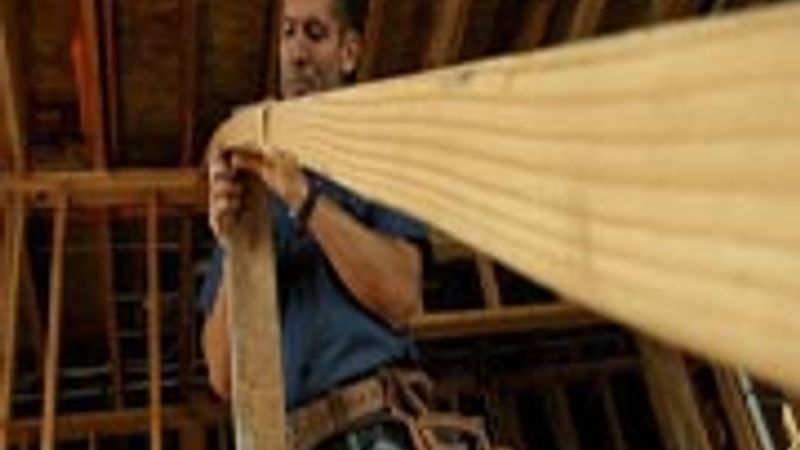
Often you need to pull a wall out or push it in. And the way to to that is to set a brace, and then use a kicker to move it one way or another. at the top of the wall, you want to make sure the bottom corner of your brace is sitting between the double top plates. If you put the brace at the top of the plates, it's just going to get in the way when you set your joists. Once you've got it where you want it, drive your nails parallel to the ground if you can. This way, as you put pressure on the brace, the horizontal nails will bend and hold fast, instead of pulling out of the plates. I usually put 3 or 4 nails.

When you set the bottom of the brace, you want to be over a floor joist so you have a solid surface to nail into. If we were going to pull this wall in, we could nail the bottom of the brace home. But we need to push this wall out, so we have one more step to do before we nail it down. To push the wall out, you're just going to sit on the brace. depending on how much you need to move, you'll want to put more weight into it before you nail it down.


Framing Floors, Walls, and Ceilings, Updated and Expanded
Builder tested, code approved $24.95 more info...


posted in: Blogs, framing, walls, lumber

Comments (9)

smalld smalld writes: as an example! if I had to redefine a wall that I had made after as your video shows attaching to joists of an upper floor I would just lay down my hammer and choose another career.
Posted: 12:52 am on October 25th

jaybirds jaybirds writes: Can anyone help me? I live in a 20yr home on a slab foundation. The 20ft high wall to the outside in a narrow 8ft area is now buckling on the inside, but the outside is not bowed or buckled.Foundation has been checked. No one seems to have an answer except to open the drywall, the exterior . I realize that this is the answer,but is this due to inadequate bracing of a two story wall?
Posted: 10:49 pm on October 22nd

Van_Steelandt Van_Steelandt writes: what kind of hatchet are you using it looks awesome.
Posted: 3:26 pm on October 18th

semar semar writes: you would not want to wait to straighten the walls out when you have all the ceiling joists on. If the opposite wall was straight and plumb the correction would throw the opposite wall out of plumb.
So, straighten the walls first, then fasten the ceiling joists.
The turnbuckle method of course is the cat's miau, especially if you frame only with one helper
Posted: 1:40 pm on October 18th

CubanORiley CubanORiley writes: This method requires to much effort and is limited as to movement. The better way is to nail the flat side of a brace on the side of a framed opening or a stud at the top,nail. Then to a block on the floor with a separate vertical piece about a third of the way from the bottom, as a lever. More movement more control. Simple machine from years ago.
Posted: 10:22 am on October 18th

slykarma slykarma writes: For the occasional framer, the solid brace system shown works fine. If you're doing a few foundation and frame projects, invest in a set of form aligner braces:
http://www.dhcsupplies.com/store/p/423-Turnbuckle-Form-Aligner-Used.html

I bought 40 of these a few years back and have framed quite a few custom home projects with them. Their versatility and durability are peerless, both for framing and wall forming. Braces can be made more or less any length needed.
Posted: 9:34 am on October 18th

Jasper_50 Jasper_50 writes: Very informative...Thanks J
Posted: 9:27 am on October 18th

redwing44 redwing44 writes: Scott,
BTW---any ideas on how to straighten an old framer's back.
Best to you. Larry Haun
Posted: 7:19 pm on October 17th

redwing44 redwing44 writes: Hi Scott,
Good job on the wall straightening. I love your rigging axe. I used one for many years.

Posted: 7:18 pm on October 17th

You must be logged in to post comments. Click here to login.