
Deck Ledger Bolting by the Code
Follow this bolting and lag-screwing schedule for fastening the ledger.
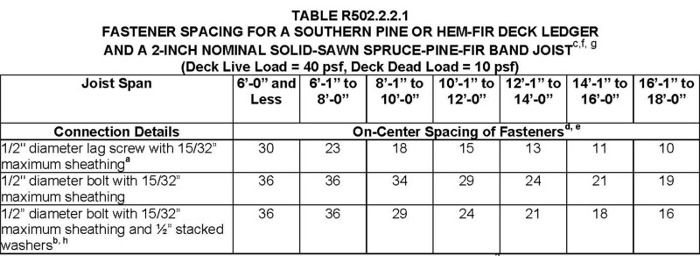
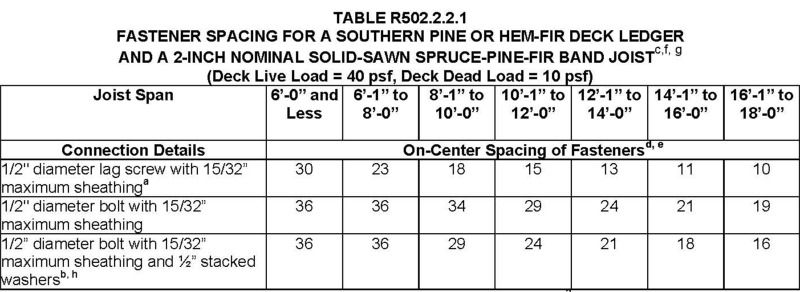
The 2009 IRC gives us a prescriptive bolting and lag screwing schedule to follow when mounting a deck ledger to a house. Table R502.2.2.1 has three options: ½ in. bolt, ½ in. lag screw and ½ in. bolt with the ledger spaced off the wall sheathing by ½ in. for those who like the flow-through design. (see photo) [NOTE: The 2012 IRC – 2018 IRC all have the same table. The only change is in the footnotes.]
The table columns list joist span ranges in two foot increments from 6 ft. to 18 ft.; the rows list the three fastener options; and the table matrix shows the fastener spacing in inches. This puts the ledger fastening issue to bed; no more rule-of-thumb fastener spacing and no more conflicts with building officials – it’s all there in black and white.
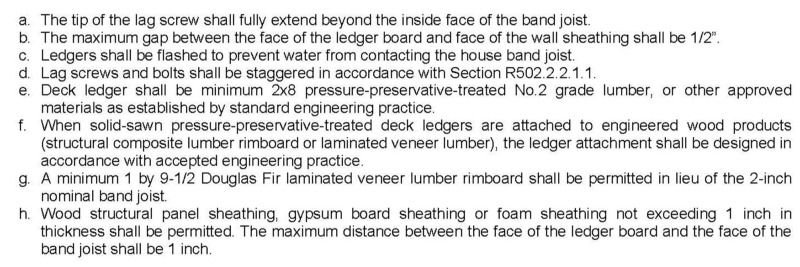
Just don’t forget to read the fine print (AKA Footnotes) beneath the table and other code sections. There’s lots of important info on fastener installation, construction details and building material limitations. (see photo)
For instance:
- The bolts and lags must be hot dipped galvanized or stainless steel.
- Lag screw tips must penetrate the house rim joist – that’s at least ½ in.
- Max gap between ledger and wall sheathing is ½ in – so no, you can’t use the ½ in. bolt with spacer option over the siding unless it’s T 1-11.
- Bolts and screws must be located 2 in. down from top and up from bottom of ledger and staggered up-down. Plus you need to double fasteners at ledger butts and ends.
- House rim joist must be minimum of 2x sawn lumber or 1 in. x 9 ½ in. Douglas Fir LVL – no attachment is allowed to strand lumber, SYP LVL, the mudsill, I-joists, floor trusses or other materials. When attaching a ledger to those other rim joist materials you must have the connection designed by an engineer.
- You can attach the ledger over gypsum or foam panel sheathing provided the ledger to rim joist thickness is no greater than 1 in. in total.
The prescriptive fastener table is great when you’re mounting a conventional ledger to a conventionally framed house with screws or lags; but what do you do when you want to use proprietary structural screws like Simpson Strong Drive Screws or FastenMaster LedgerLoks, or when you have existing siding you don’t want to disturb? There are solutions and I’ll address them in future postings.
More Information:
-
Table R502.2.2.1
-
Footnotes to Table R502.2.2.1
-
R502.2.2.1.1


View Comments
This is a good idea.
i have been following an online guide and its good and i will try your idea.
thanks
Sorry i forgot to mention the guide.
http://www.hometoolsdepot.com
Regarding 1 1/4" TimberStrand - it is a product that is an alternative to dimensional lumber. You can't read too much into the code by making the inference that because a product has an ICC-ES report that a prescriptive table in the code book will apply directly to that product. Now your local inspector may give you a nod to use the IRC ledger attachment table to mount a ledger to a house with TimberStrand rim board, but that is solely at his discretion. I'd check with my local official before trying it.
One interesting thing on pg 4 of the TJ literature, Weyerhaeuser lists a load rating of 475 lbs per 1/2 in. "lag bolt". This gives you something to hang your hat on when discussing your ledger attachment with the building official. Of course, Weyerhaeuser only lists 'lag bolts' and not through bolts.