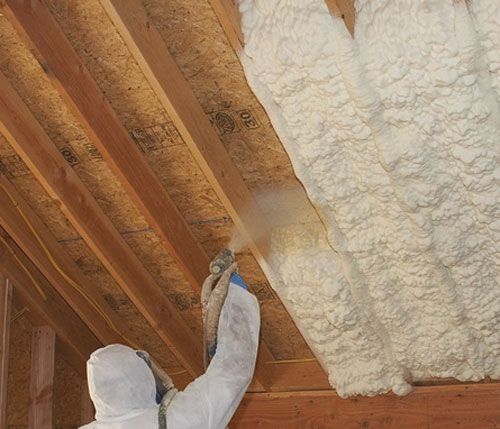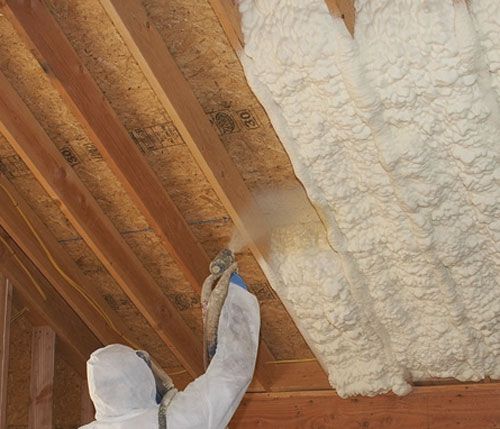
Rich Cowan lays out his plans in a Q&A post at GreenBuildingAdvisor. He’s going to insulate the roof and gable-end walls, turning the unconditioned attic into a conditioned space. He’d like to use spray-in polyurethane foam and has contacted two installers. One proposes 5 in. of closed-cell foam beneath the roof deck and another 3 in. in the gable ends. The second installer would use open-cell foam but completely fill the rafter bays plus add 3 1/2 in. in the gable ends.
Closed-cell foam forms its own vapor barrier. But if chooses the low-density, open-cell foam, he’ll have to figure out the most economical way of adding a separate vapor retarder.
As Cowan juggles these two approaches, he’s faced with another challenge. Whether he uses open-cell or closed-cell foam, it must be protected by a fire retardant layer to meet code. That could be a layer of drywall, or an intumescent paint. Although the paint would cost $750, he could spray it himself. Framing the entire attic for drywall would add thousands of dollars to the job.
The unexpected complexity of Cowan’s energy update is the subject of this week’s Q&A Spotlight.
Read the whole article at Green Building Advisor.