Stove Moving Day
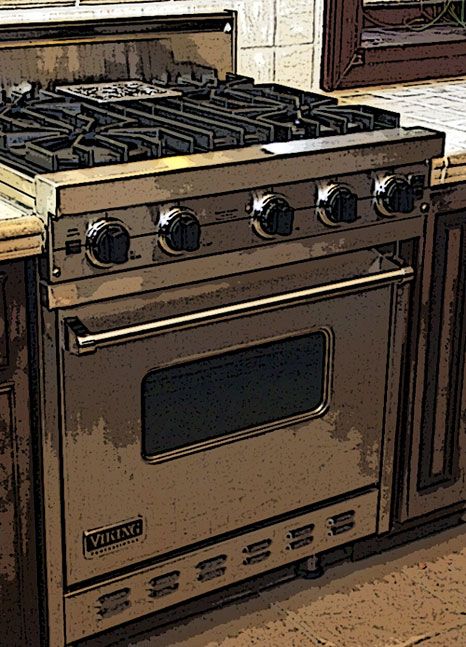
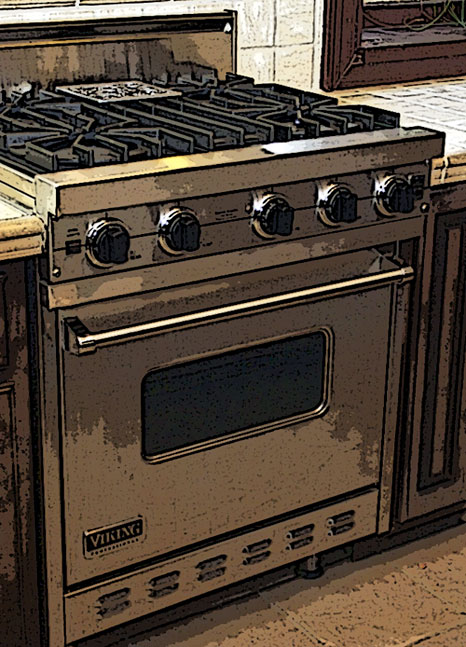
My wife Pat is a legendary cook. So, when we built our house in New Jersey 15 years ago, we designed the kitchen around a cook’s stove – a 48 inch Viking with six burners, two ovens, and a griddle. Viking stoves weigh ten lbs to the inch. This one was 480 lbs. Its hood exhausts through two 8 in. vents – the same diameter as the main guns on the USS Indianapolis. The hood requires its own fresh air intake, or it will backdraft my oil burner.
Now, another thing Pat does really well is get stuff cheap. It’s embarrassing, really, to watch her negotiate price with someone – Imagine the New England Patriots taking on a high school football team. I just get out of the way. Our Viking range was used, lightly. It turned out the first owner was allergic to something in the propane gas the stove burned, and we bought it for less than half of retail. Good thing too, because even at that price I swore I’d never pay that much for a stove again. I don’t remember the details of moving the Viking that time. Probably my best friend Mark was in on it. We were both in our mid-30s at the time, and in the fullness of manhood. Toting around a quarter-ton stove would have seemed de rigueur. Mark is a perennial bachelor who gets roped into helping whenever I have anything heavy to move. (Pat’s cooking is so good, he kept coming back even after the time we dropped 300 lbs of statue on his foot. But that’s another story.)
We moved into that new house in March of 1996. Seven months later, Kevin Ireton hired me as an editor at Fine Homebuilding. Anticipating a move to Connecticut, we put our new house on the market with the stipulation that the Viking would come with us. I rebuilt the kitchen cabinets in that area so the new owners could install a standard 30 inch range.
It took a year to sell our Jersey house, a time I spent learning the ropes at FHB, renting a room in Connecticut, and coming back to my kids, my wife, and her Viking, on weekends. Once the Jersey house was under contract, I scrambled to find a rental in Connecticut, planning that we’d rent while we found land and built again. Fine Homebuilding hired movers, so I didn’t break a sweat over the Viking that time. The movers put it in the walkout basement of our rental home. I first saw that basement in the fall, when it was dry. In the spring, I found that the basement was damp. In fact, damp barely describes it. There was running water at times. Occasionally, I heard a frog.
Over the next two years we built our current house, with another kitchen designed around the Viking. I do remember moving the Viking into this house. My friend Scott stopped by to help just as I was puzzling how to get the Viking off the ground and into the back of my truck. With his help, and that of a couple of neighbors, we managed. But when Scott and I got to the new house, it was just him and me. Happily, the porch was at the level of my truck’s tailgate, so there were no elevation changes to contend with. Just a quarter ton of stove. Scott and I squatted like Sumo wrestlers, and each grabbed an end of the Viking. Searching deep in each other’s eyes for any hint of weakness, we slowly straightened up. To our mutual surprise, the Viking rose with us, and we carried it inside, where it provided the heat for innumerable excellent meals over the next decade.
All was not well, however. The time the Viking spent in our damp basement had consequences. The Viking developed issues, mostly from rust clogging the burners and corroded thermocouples giving up the ghost. If you think buying a Viking is expensive, try hiring someone to come to your house and repair one, particularly in Connecticut where the smallest unit of currency is apparently the hundred dollar bill.
We limped the Viking along. One oven died. The igniters on the burners started to go, one by one, but they could be lit by hand. The fuel mixture at two of the burners got befuddled, and the yellow flame coated the pots with soot and no doubt filled the air with CO. We stopped using those burners. The broiler stopped broiling. The door on the remaining oven stopped staying fully closed. I applied a carpenter’s solution, holding the door shut with a wooden wedge. I made the wedge from cherry so it would at least smell good as it gradually charred. A few months ago, the second oven died. Considering the cost of repair, we decided a Viking funeral was in order.
But what to replace the Viking with? I had sworn never to spend that much on a stove again. And I didn’t. I spent more. I love my wife beyond reason, and when she found another Viking on Craigslist, what could I say? Fall was approaching, and Pat makes the planet’s best pumpkin pie, gingerbread, and springerle cookies. Facing Thanksgiving and Christmas without them was unthinkable. We went to look at the replacement Viking, 70 miles away in a controlled-climate storage unit in Kingston, NY.
[[[PAGE]]]
This Viking had a pedigree. We do live in Connecticut, after all. According to the seller, he bought it from Martha Stewart’s TV studio, whose appliances were being swapped out because Martha had changed sponsors. The new Viking was in great shape – no rust. And, it was bigger, with six burners, a griddle, a grill, and two ovens. Sixty inches wide, 10 lbs to the inch. 600 lbs. Pat negotiated a price while I put my fingers in my ears and whistled. We paid a deposit, shook hands, and agreed to come back in two weeks for our TV star Viking.
It is a good thing I’d never actually finished the kitchen in our new house (Note to the young – never marry a carpenter if you expect to live in a finished house). I was going to have to re-frame the stove nook for the new Viking. But that wasn’t the first thing on my mind. Stove Moving Day had me worried. The number “600” kept reverberating. Most of my friends are now over 50. Yikes. There was Mark. What can I say? He’s a mensch. And Kevin Ireton, who’d gotten me into this mess in the first place by hiring me way back in ’96. And Dave and Jim, and my son Kevin, the only youngster in the crowd. And Jim’s son Tim promised to come over and help get the Viking off the truck.
That was only 100 lbs a person, less on the Connecticut end – pretty workable. Plus, Pat and I rented a truck with a lift gate. I cannot speak well enough of lift gates. Their inventor deserves hosannas and great wealth. I started to feel okay about Stove Moving Day. But then the Kevins bailed out. My son got a job. What was I going to say to that? “No. Don’t go to work and earn money so I don’t have to pay your entire college tuition.” Right.
A Siren of a tropical storm rolled up the east coast, calling Kevin Ireton to Chincoteague to take advantage of the great surfing left in its wake. He was gracious about it. “Andy,” Kevin said, “will Pat still invite me over for meals if I skip out on moving the stove?” Kevin had spent most of his free time the previous summer helping me to build my garage, so what else could I say? “Surf’s up!”
It was still only 150 lbs. per man. We could do it. I scrounged some dollies. And in fact, Stove Moving Day went off without a hitch. While I had the truck, I also used it to pick up a pile of salvaged pine, and a 60 year old Walker-Turner tablesaw I bought that week to replace my far newer boat anchor of a Chinese-made saw whose manufacturer I can’t name in polite company. Hey – If Pat got a new stove, I at least deserve a power tool from the golden age of American manufacturing.
[[[PAGE]]]
And here’s my favorite part. For my money, one of the best bits of theater is the St. Crispin’s Day speech in Shakespeare’s Henry V, just prior to the English victory at Agincourt. Talk about inspiring! Makes me want to go out and battle the French myself. Here’s a link if you’re not familiar with it: www.youtube.com/watch?v=cRj01LShXN8&feature=related
Mark and I had seen Henry V together years ago, and when he heard of our dwindling numbers, he adapted that speech to Stove Moving Day. With thanks to Mark and apologies to the Bard:
That he which hath no back for this lift,
Let him depart; his passport shall be made,
And crowns for convoy put into his purse;
We would not lift in that man’s company
That fears his vertebrae to lift with us.
This day is call’d the feast of Stove Moving Day.
He that outlives this day, and comes safe home,
Will stand semi-hunched when this day is nam’d,
And rouse him at the name of Stove Moving Day.
He that shall live this day, and come whole home ,
Will yearly on the vigil feast his neighbours,
And say ‘To-morrow is Stove Moving Day.’
Then will he strip his Truss and show his scars,
And say ‘These hernias I had on Stove Moving Day.’
Old men forget; yet all shall be forgot,
But he’ll remember, with aches and pains,
What feats he did that day. Then shall our names,
Familiar in his mouth as household words-
Andy the limping, Mark the herniated, and Dave,
Jim, and Tim of crushed vertebrae-
Be in their flowing cups freshly rememb’red.
This story shall the good man teach his son;
(lift with your legs and not your back)
And Stove Moving Day shall ne’er go by,
From this day to the ending of the world,
But we in it shall be remembered-
We few, we ruptured few, we band of lifters;
For he today that pulls his groin with me
Shall be my brother; be he ne’er so vile,
This day shall gentle his condition;
And white collar workers in office cubicles, half asleep
Shall think themselves accurs’d they were not here,
And hold their tunnel-carpel syndrome cheap whiles any speaks
That lift and hoist with us upon Stove Moving Day!!
–Andy Engel, the former executive editor of Fine Homebuilding, is a now writer and carpenter specializing in decks (www.engeldecks.com). Andy has written several books for The Taunton Press, including For Pros/By Pros: Building Stairs. He co-authored the Taunton Press book, Wood Flooring, and his next book, Carpentry Complete is due out in the Fall of 2011.
















View Comments
I love it!
Brilliant adaptation...I could hear Laurence Olivier reading along with me!
Well, thank you. That is high praise.
that was GREAT! what a fun post...I need to lift something
Now that's what I call a story. It's things like this that really make me proud of what I do as a mover and removalist. Sometimes there are just such precious items in our customers' house that we just can't help but feel so happy to help them take care of their things when we come over to help with the moving.