
Wire-Stripping Tips for Roughing in an Electrical Box
Learn some time-saving tricks for handling plastic-sheathed cable.
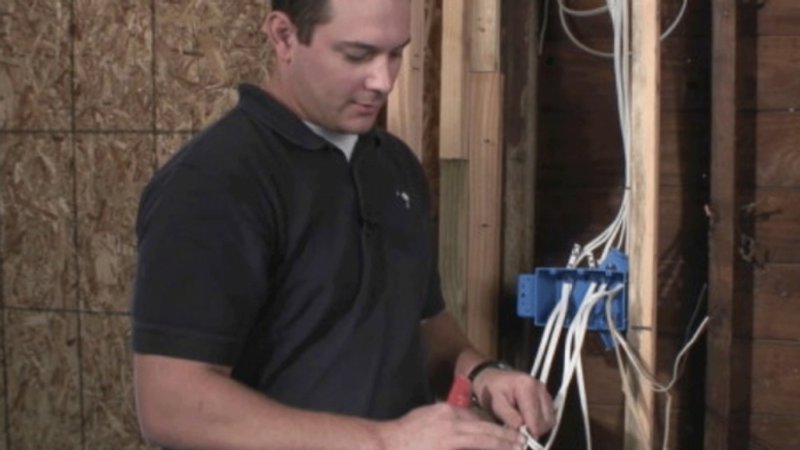
3 Tips for working with plastic-sheathed cable
With Brian Walo
1. Quickly and safely expose the copper conductors
Here’s one reliable way to get the insulation off of nonmetallic sheathed wires without cutting yourself or damaging the wire. First, grab the cable so that about 1-1/2 inches is sticking out past your hand. Stick the point of your utility knife into the center of the protruding piece of cable and push it away from your hand, splitting the sheathing down the middle. Then, grasp the exposed wires in one hand and pull the sheathing away with the other – it should just tear down the middle. If using this method, be sure that when you rough in your wires there’s enough wire extending out of the box so that the last couple inches will get cut off. This way it doesn’t matter if you nick the copper conductor with your utility knife.
2. Keep track of your wires
When you rough in the wires, all the cables should be labeled with a permanent marker so you know what they will connect to. You can keep those labels and reuse them to permanently mark the purpose of each wire in the electrical box. Before you strip the sheathing, cut off the section of sheathed cable that has the label, slide the labeled sheathing off of the conductors, and temporarily tuck it into the hole where each cable enters the electrical box. When it’s time to wire the switches, receptacles, and other devices, just slip those labels over the conductors before you connect them.
3. Cut off the loose sheathing
Once you have the labels in place and the sheathing pulled back, it’s time to remove the excess sheathing. Brian suggests using diagonal cutters (also called dikes or side cutters) for this last step. Grasp the loose sheathing in one hand and snip the loose sheathing with the jaw of the cutters, about 1/2-in. from where the wire comes into the electrical box. This way you will keep the 1/4-in. minimum of sheathing protecting the wires where they contact the potentially sharp edges of the box.
More on Electrical
Running New Wires through Old Walls – With an assortment of tools, a few tricks, and a little luck, you can make electrical cable go where you didn’t think it could.
Ten Common Wiring Problems – A master electrician details some frequently found mistakes that could cost you your house or your life.
The Indispensable Digital Multimeter – In this article, electrician Brian Walo explains what to look for in a digital multimeter: style (some meters include a split fork, a hook, or a clamp), leads, display, the maximum number of amps the tool can read, whether the DMM has an auto-ranging or manual-ranging feature or both.
Video Series: Install a Subpanel – Whether you’re building an addition or renovating an existing space, a new subpanel may be the easiest way to add electrical circuits to a house. In this video series, a licensed electrician shows you everything you will need to do the job right.

View Comments
Fantastic! Thanks the taking the time and making the effort to share your expertise.
Tonawanda