TRENDING ON FINEHOMEBUILDING

previous
  • Read FHB on Your iPad
    Read FHB on Your iPad
  • The Hobbit House and More
    The Hobbit House and More
  • Outdoor Kitchen Inspiration
    Outdoor Kitchen Inspiration
  • All about Roofing
    All about Roofing
  • 15 Coffered-Ceiling Ideas
    15 Coffered-Ceiling Ideas
  • 7 Small Bathroom Layouts
    7 Small Bathroom Layouts
  • 9 Concrete Countertops Ideas
    9 Concrete Countertops Ideas
  • Clever daily tip in your inbox
    Clever daily tip in your inbox
  • 7 Smart Kitchen Solutions
    7 Smart Kitchen Solutions
  • 12 Remodeling Secrets
    12 Remodeling Secrets
  • Remodeling in Action
    Remodeling in Action
  • 2013 HOUSES Awards
    2013 HOUSES Awards
  • 2014 HOUSES Awards
    2014 HOUSES Awards
  • What’s the best decking?
    What’s the best decking?
  • Basement Remodeling Tips
    Basement Remodeling Tips
next

Building Business

Building Business


More on balance sheets (2): Collateral and revaluation

comments (0) November 3rd, 2011 in Blogs

More on balance sheets from Sal Khan.

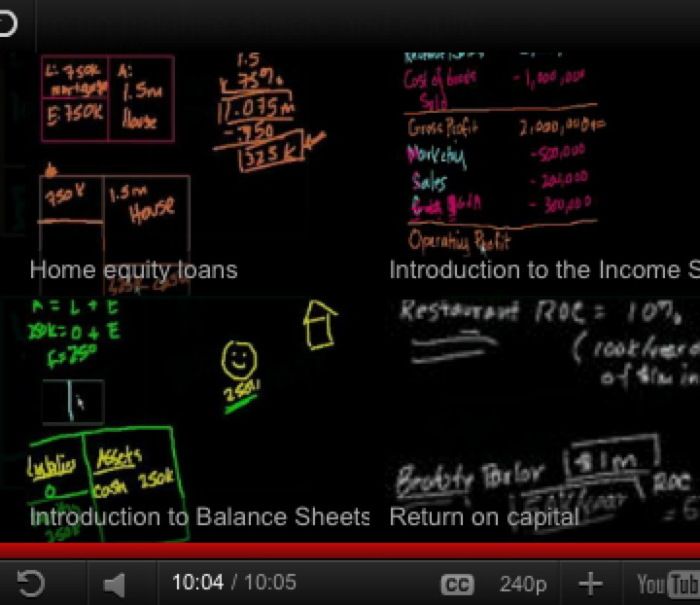
Here, Sal expands on the balance sheet from the previous episode where he bought a $1 million house with $250k cash and a $750k loan from a bank.


Assets = Liabilities + Equity

$1M = $750k + $250k


He expands a bit on the balance sheet with a quick overview of how loans work, introducing the terms 'collateral,' 'revaluation,' and 'marking to market' into the conversation.

Collateral is what we tell the bank they can keep if we do not pay our debt to them.

Revaluation, or marking to market, is assigning a new value to an asset  (marking) if the real world (the market) dictates it.

Every so often, in order to be honest with ourselves, we need to revalue our assets, and rebalance our balance sheet.

  • If the value goes down, then equity must go down because liabilities must stay the same.
  • If the value goes up, then equity goes up because the liabilities must stay the same.

Liabilities have nothing to do with market value except in securing the loan and convincing the bank that the house is sufficient collateral.


More DIY MBA articles


This video comes from www.khanacademy.org


posted in: Blogs, business, diy mba

Comments (0)

You must be logged in to post comments. Log in.