The Self-Taught MBA: David Gerstel on Running a Successful Construction Company
You have to work hard to maintain integrity. Everybody thinks they have integrity, but it's not an attribute like being blond or tall. You have to will it, and hold yourself to high standards.

Browsing Amazon’s list of 100 best-selling books in the “Home Building and Construction” category, I found just two devoted to the business of building. One leans heavily toward commercial construction, the other, just a few titles below an illustrated tract on chicken coop design, is David Gerstel’s “Running a Successful Construction Company” (The Taunton Press, 2002). It hasn’t been updated in a decade, but don’t worry, in this interview I asked Gerstel to tell us what he’d add if he were to write his book today.
How early in your career did you unbuckle the tool belt and focus on the business side?
It took a while. When I came out of college with a BA in history, I had no idea I was headed for a career as a builder. I just knew I wanted a work life that combined physical movement with my other passion, writing. I got lucky and stumbled into construction, One of my first tasks was digging a ditch, 12-in. wide, 18-in. deep, straight across a rolling hillside in Northern California. I loved the all out effort – and to my eye that cleanly cut trench was a thing of beauty. I apprenticed to a couple of top notch carpenters and was captivated by their work and by their athleticism. Soon I became fascinated by the building process itself, by the co-ordination of all the different trades. And then I got laid off.
People think it’s hard nowadays, It is. It was hard then, too. Between 1972 and 1982, we experienced three recessions. The construction industry got hammered. At my union hall the unemployment rate hit 95%. I was struggling to get work of any kind, even going door to door, when my wife suggested, “Why don’t you get your general’s license?”
Articles by David Gerstel
Running the Company
Although 15 years old, these ideas on organization and management for builders outlined in this article are still sound
Organizing the Project (member only)
How one builder creates order at the job site
So you wrote a business plan, devised a marketing strategy and opened an office, right?
No. I didn’t know what a business plan was, or a spread sheet, or overhead, or much of anything about business. But somehow I passed the test and began to contract for small jobs. I did them as well as I possibly could, and lo and behold, the small jobs led to larger ones.
I didn’t recognize it then, but I had already developed skills that are essential for the self-employed: Attracting work, recruiting and organizing a workforce, and crunching numbers. Early in my career, I found help with the nuts and bolts of running a company – especially at the meetings of some very smart builders who called themselves the Splinter Group and were pushing one another to become more skilled at the business side of building.
So how long were you a contractor before you wrote your book?
I’d been a contractor about eight years, and no, I was not ready to write the book when I started it. That’s why it took me years to complete the first edition. Researching and writing the book was, essentially my MBA program. I got into it more or less by accident. One morning down at my neighborhood coffee shop, I met a guy named Chuck Miller. He went on to a storied career as a FineHomebuilding editor, but then Chuck had just started his job with the magazine. He invited me to submit articles including the one you referenced in your first blog. They were about basic stuff but got such a strong response that I got the big head and decided I was the very guy to write the book about how to run a construction company. I had not even completed a table of contents, however, before I realized I did not know nearly enough to write the book. So I started researching: reading, interviewing other builders, especially the Spllinter Group guys.
The effort paid off. The book is now in its second edition with some 100,000 copies in print. As I tested out the ideas for the book in my own company and continued studying – especially Ben Graham, Warren Buffett’s mentor – I developed a philosophy of business that emphasized frugality, careful use of all resources, and sustainability. Not everyone agreed with my frugal approach in the boom years. Many contractors preferred the NARI (National Association of the Remodeling Industry) model. They emphasized projecting a professional image, so builders bought beautiful new trucks, and built impressive offices and shops. I drove an aging GMC pickup, and I ran my company out of 50 square feet of office space.
Did the frugal approach pay off?
A lot of my friends and mentors built sizeable companies. They prospered and spoke of creating a “legacy.” But now mostly, they feel like hell – exploited, scared, and trapped. Excess overhead crushes you. You don’t need a highly polished image, fancy offices, or elaborate software that requires specialists to keep your systems running. To put it bluntly: Building is wonderful work but a lousy business proposition. On a rolling decade basis, it generates weak margins in return for perilous risk. The higher the ratio of your fixed overhead to your direct costs, the rougher the ride you will have through the ups and downs of the economic cycle. When hard times come, they hit the construction industry like a sledge hammer. From my reading of Ben Graham, I learned it was not wise to pump money into a financially marginal business, much less into my image. I ran my business so that I could scale it down quickly and not have to bleed cash in order to keep my company going through a bust. Recent history has underscored the value of frugality.
Today I feel very, very lucky and even something approaching survivor’s guilt when I see what has happened to friends – burning through their life savings, going bankrupt, feeling pessimistic about ever retiring.
If you were rewriting your book today, what would you add to it – maybe a chapter on Twitter?
Not a chapter on Twitter. But I would give more emphasis to marketing beyond your base of satisfied customers. I think you have to reach further now, so I would explore creative marketing strategies. I’d also give more play to reducing costs through the use of computer technology, and to the design-build and developer models that involve working more with subs and doing less work in-house, which limits financial risk. But mostly I would even further intensify the book’s focus on integrity and careful use of resources.
You have to work hard to maintain integrity. Everybody thinks they have integrity, but it’s not an attribute like being blond or tall. You have to will it, and hold yourself to high standards. Trying to do the right thing simplifies your decisions and cleans up your business model, for it goes hand-in-hand with operating lean. Employing resources with care and respect — whether a box of trim-head screws or your relationship with your tax accountant – that is integrity.
Among the guys who are surviving today, you find a deeply ingrained respect for the need to manage costs, especially overhead, astutely. It’s not the guy that says, “Times are tough, we’ve got to cut back.” It’s the guy that didn’t bloat his business to begin with. But good management here does not mean cutting corners or shortchanging people.
Stinginess can be as wasteful as sloppiness. There is such a thing as resources well spent. I shared our company’s profits with my employees. I ran a very lean, but hopefully not mean, enterprise. I try, to do good work, to invest the time to be both candid (easy for me) and civil with people (a little harder for me), and then always to do exactly what I say I will do.
If I write a third edition of the book, I will further emphasize something else that took me a while to learn. I struggle with it still: Take time away from today’s pressing problems to think about larger issues. In other words, try not sacrifice the important to the urgent. If you get too caught up in the day-to-day,you can lose the decade.
If your son- or daughter-in-law wanted to go into the construction business today, what career path would you advise?
There’s more than one approach. But I suggest putting your business systems in place while you work for others. If you’ve learned your trade and then are lucky enough to find an office job in a construction company, grab it. You may observe as many flawed practices as good ones, but you’ll see people addressing business issues on a daily basis. You will learn in advance what they are rather than tripping over them in the dark while you are running your own company. Either way, as you organize your business, seek out the best information you can find, especially at builders’ associations and in books.
You’ll need a base of operations. So set an office up in a corner of your home. Create your basic marketing, estimating, accounting, and project management systems. Use them for side jobs and work out the bugs. When you feel ready, hang out your own shingle.
You have a new venture called “The Considerate House,” what’s that about?
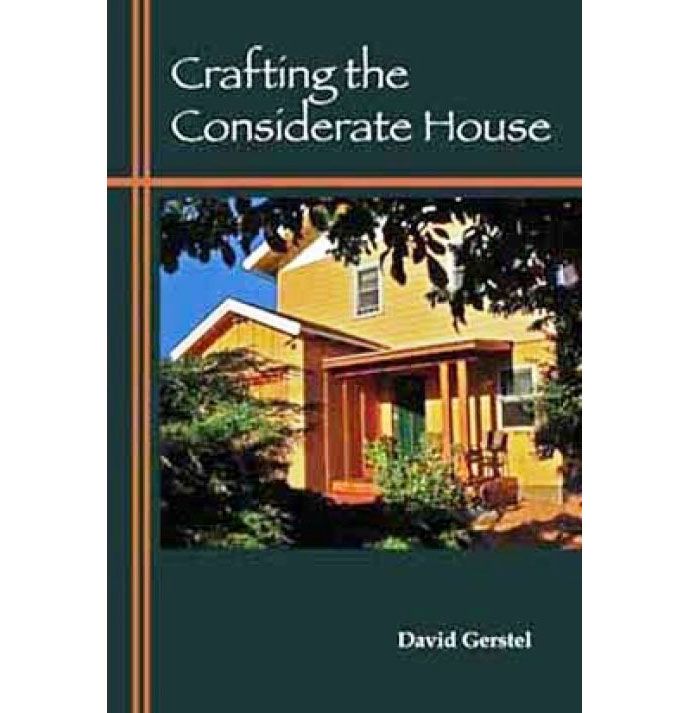
I have written another book, Crafting the Considerate House. It’s a nonfiction story about the financial, esthetic, and environmental challenges I faced in building a really good, extremely efficient house for people of moderate means. It’s not a how-to-build-a-house book. It’s a “what and why” book. I think it could be better. But I do hear from readers who find it a lively account of the challenges you take on when you set out to craft a house from the first conceptual drawings through the finish details. You can read excerpts from the book on my Web site at www.consideratehouse.com.
Are you going to write another business book anytime soon?
You’ve got me thinking about it.
-
Long-time builder, master carpenter, and author David Gerstel offers insight into building and running a construction business that can roll with economic ups and downs
-
Long-time builder, master carpenter, and author David Gerstel offers insight into building and running a construction business that can roll with economic ups and downs















View Comments
I was just thinking that I should dig out my copy of David's book and read it again - An updated edition would be AWESOME.
David's book helped me a lot when I was a small-volume remodeler. From finding time for the sport's page to setting up the jobsite for productivity to figuring overhead and billing rates, it pointed to a much more profitable method for nailing wood together.
I have given out at least a dozen copied over the years.
i have referenced davids first book alot over the last ten or so years and it has been very helpful.I have put alot of thought into the four day work week espesically in this bad economy saving travel time has become more important than ever. thank you for that great easy to read book and please keep writing. A Palmieri palmieri custom builders
Do check out David's latest book,The Considerate House, while not about business, it is a business book in that David shares the highly personal experience of a culminating opus, the project that sums up and expresses through the medium of concrete and lumber, one builder's lifetime in business, craft and personal development. Your business is more than money, it's you and the way you live.
I would also really like to see a third edition of David's book. There is something refreshing about his ability to both love building as a job and be completely awake to its business challenges. I totally agree with him about not overinvesting in a such a volatile and potentially cutthroat business, and remain proudly fancy truck free. Plus, my truck was made in the days when they had sensible centers of gravity.
His emphasis on the value of experience at someone else's risk is also extremely wise. My own career proves both the benefits and downside to self education. While self education makes me very reflective and careful to really know what I am doing, I don't always know what I don't know and could easily take on work I will regret for that reason.