Sidewinder circular saws are relatively simple. Aside from the need for lots of cutting power, it’s the features that separate one saw from the next.
We recently reviewed 14 sidewinder circular saws and found seven features that separate the good from the not-so-good. Let’s take a closer look.
The first thing to consider on these saws is the cut line indicator-the little pair of notches in front of the saw’s baseplate. It helps you line up your blade with your cut line, and that’s important whether you follow a line all the way through your cut or just make a V-mark and go. You need to know that the blade is right on the money, both 90 degrees and 45 degrees. A good marker accurately delineates both sides of the blade kerf so that you can cut to either the left or right side of your line. An oversize or misaligned marker is going to need to be supplemented by a scratch awl or a fine point permanent marker.
More Tool Reviews
Kobalt’s impressive new 18V drill driver
Tool-Test Preview: Compact Compressors
Pneumatic cap fasteners replace hammer staplers
Paslode Cordless Roofing Nailer
The second thing to consider with these tools is blade visibility. A clear line of sight to the blade is crucial because, depending on your stance or how far in front of you you’re reaching when using the saw, you aren’t always going to be able to see the cut line indicator. In those cases, this little window through the appendages of the saw is all you have to be able to tell if the blade is on the line. The best saws offer a clear view of the blade through this window, at all depths of cut, even with both hands on the tool. Poorly designed saws obstruct the line of sight with handles, guards and spindle locks.
The third thing to consider is the bevel function on these tools. Now, it’s not going to be used all that often for just trimming studs to length or breaking down a sheet of plywood-but when you’re doing more complicated framing, like roof work, you really need to have an accurate setup. The best saws have a bevel lever or knob that is comfortable to operate and locks securely. Top saws also include a large scale with detents at the most commonly used angles and an easily operable override function that lets you go beyond 45 degrees when necessary. Engraved or cast-in numbers are highly preferred.
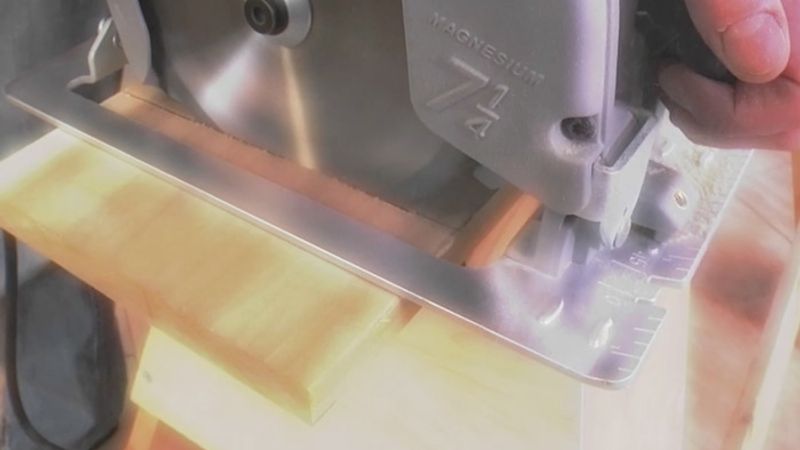
The fourth thing to consider is the saw’s baseplate. Ideally, it should be flat across the length and width, and have a nice straight left edge for riding against a guide. Stamped aluminum baseplates bend easily if dropped, but can be bent back into place for a quick fix. Cast aluminum or cast magnesium baseplates are stiffer and less prone to bending. But a good drop usually means a cracked plate with no chance of fixing it. Fiber-reinforced plastic baseplates are super-tough, but they should be made thick enough to be stiff, since they often have more flex in them than the metal alternatives.
The fifth thing to consider on these saws is the guard retraction. There is nothing more frustrating than being halfway through a cut, and the guard gets stuck and won’t retract, so you have to stop and reach over the saw to loosen it up. Saws with a large lobe above the leading edge of the guard are among the best. Those with sharp or rough leading edges tend to get stuck when cutting in angles and on regular wooden surfaces.
The sixth thing to consider is the saw-to-baseplate connection. This is the pivot point on the saw where the motor and the handle assembly meet the baseplate. That’s the part of the saw that allows you to plunge for the depth and pivot side-to-side for bevel cuts. The best models have a saw-to-baseplate connection that’s in-line with the rear handle, and a front handle that’s both low and also in-line. Saws with a cantilevered connection that’s in-line with the blade guard instead, and a front handle that’s located far out on the motor housing, are more prone to flexing when pushed through a cut.
The seventh thing to consider is the placement and operation of the depth adjustment lever. Besides being just plain easier to reach, outboard levers let you keep your trigger hand on the handle, where it belongs, while you finesse the exact blade depth and lock it into place. Inboard levers, which are tucked between the handle and the blade guard, are more difficult to operate. Rubber-covered or thick, rounded levers are the nicest to grasp. The depth scale should be clearly marked and easy to read. Again, engraved or cast numbers are more permanent than stickers.
For such a simple tool, these saws have a lot of features to consider. The bottom line: None of them are perfect in every category. I’ve laid out the seven features to consider, but it’s up to you to determine which is most important for the work you do.









View Comments
I don't know why anyone would want a circular saw with the blade on the wrong side. That has to be the most dufus design ever. For a right handed person a left blade is the only way to saw with confidence, balance and precision. Saw makers still are missing the mark in there product lines.
SamScott, I'll bet left handed people think most circular saws are designed on the wrong side and are happy to find one designed for them. Thank you Justin, nice breakdown of design elements.
In reference to SamScott54's remarks: "I don't know why anyone would want a circular saw with the blade on the wrong side. That has to be the most dufus design ever." Sam, I used to feel the same way and understand your remarks. I am a right handed carpenter that buys and uses left handed circular saws because the left handed design allows me a clear view of the blade. The Porter Cable Framesaw is the one I am using currently. HOWEVER, THERE IS A REASON THAT THESE SAWS ARE DESIGNED IN WHAT SEEMS TO BE BACKWARDS - IT IS EXTREMELY DANGEROUS TO USE A CIRCULAR SAW DESIGNED FOR A PERSON THAT IS OPPOSITE HANDED. The current design of circular saws uses the length of the motor to separate the blade from the carpenters left hand which typically supports the work piece. For some reason a right handed person will instinctively will let the left handed saw baseplate ride against their left thumb while pushing the saw blade into their left hand hidden under the work piece. I have seen an experienced right handed carpenter using a left handed saw cut off his entire little finger and two joints of his ring finger on his left hand working as I just described. For this reason I will not loan my left handed saw to any right handed individual and caution anyone considering using a circular saw designed for opposite handed people to carefully consider this very dangerous practice. Having said this, I personally like the ability to clearly see the blade and am willing to take the risks involved because I am so well aware of these risks.
katty1: Left handed people can see the blade of a right handed saw very well and do not think the saws are designed for the wrong side. The insidious thing is that left handers using right handed saws is an exceptionally dangerous practice for the reasons I previously described.
Interesting discussion guys, and good feedback. Goodnich - I'm curious to know if what you're saying about the blade position on these saws is your opinion, or whether you heard that from somebody involved in the design of circular saws?
Reference JFink's comment: Justin, I haven't spoken to any tool designers prior to stating my observations here. These observations are based on the current design of direct drive circular saws. Right handed models have the blade on the right side of the motor. Left handed models are the opposite. This design obscures the users view of the blade, but provides a safer distance from the spinning blade to the hand that supports the work piece. An analogy would be observing that drivers of automobiles in North America are seated on the left side of the vehicle. In the UK, drivers sit on the opposite side - the right side. This is the design convention and it is not necessary to speak to a designer to observe it.
The accident I described in my previous post would have been much less likely to occur if that right handed carpenter had been using a right handed saw.
Assuming that you are right handed, you can better understand what I am describing here if you turn any of the right handed saws you reviewed 180 degrees and pretend to execute a cut. You will immediately notice that you can see and possibly even control the blade much better, BUT that the blade is much closer to your left hand - so much closer that it creates a hazard.
SamScott54 is correct that the design seems backwards, but there is a valid safety reason that this is the case.
The design isn't just for safety. On a sidewinder, the motor rests on the baseplate which rests on the workpiece during a cut. With a worm drive, the motor and baseplate rest on the scrap piece which will fall away at the end of a cut. I used worm drives for years, but switched back to a sidewinder when I noticed a slight bevel on the workpiece from the saw tilting just a bit as the scrap piece fell away. I was a die-hard worm driver for years.
I also have a caution for composite baseplates. Manufacturers claim they'll withstand longer falls than ametal baseplate. The composite may not break, but check it for squareness to the fence (parallel) after the fall. A sawblade that is not parallel to the fence is very dangerous, it will increase your chance for kick-back tenfold. It can happen to metal too, but for some reason the composites seem more vunerable. I went through two composite saws before I swore never to buy one again. The second one came out of the box so crooked that I never even made my first cut with it. These weren't cheap saws.
As a matter of fact, it amazes me just how many $100 saws that come out of the box that are not parallel. The Makita that I bought is ever so close but still just slightly out of parallel. I checked every saw on the shelf and for my budget, the Makita was as good as it got. For that kind of money, you shouldn't even have to check them. I'm just a part time sawdust junkie, bought this has been my experience.
I am left handed and only use worm drive saws. I do not like the blade on the right side. Left handed people are used to tools not designed for them.
I'm right-handed and use both a right and left-handed sidewinder. I use the right-handed saw when doing lumber cutoffs since the weight of the saw sits on the supported length of lumber and your hands are in a safe position (and I grew up this way). I use the left-handed saw with a straight edge for ripping sheet goods right to left. Again the weight of the saw is on the supported side of the cut but now I have a better sight line and greater reach with both hands. If I had to choose one I'd stick with a right-handed sidewinder for the sake of cut-offs.
Porter Cable makes a left blade circular saw. I have been using this saw for several years after using a worm drive saw; it is about 7 lbs lighter and visibility of the blade is great.