Choosing Trim Nailers: Which Finish Nailers Should You Own?
If you had to pin me down to just one nailer, it would probably be the first one that I bought, which is the 16-gauge. You can use it for small projects and big projects.
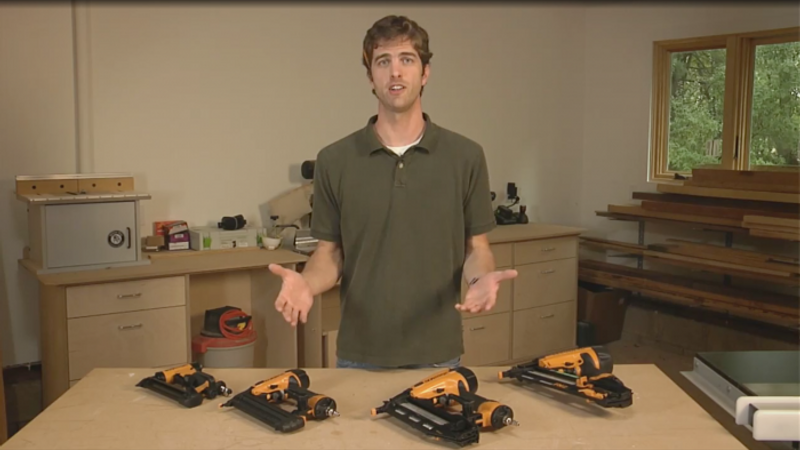
Most finish carpenters probably use the full range of pneumatic nail guns, from pin nailers to brad nailers to heavy-gauge trim guns, but can’t the average carpenter or homeowner get by on one or two sizes?
One of the major factors to consider when choosing a finish nailer is the size or gauge of the nails it fires. Now trim carpenters are going to want to have a 15-, 16-, 18-, and 23-gauge nailer at their disposal. But a homeowner is probably only going to want to have one. So which one do you choose? Is a cordless nailer a good option? Let’s take a closer look.
The gauge of a finish nail is a measure of its diameter, just like an electrical conductor. The higher the number, the thinner the nail; the lower the number, the thicker it is.
The real anchors of the pneumatic-trim-nailer team are 15- and 16-gauge nailers. These two tools fire nails up to 2-1/2 inches long, and are the most versatile for interior carpentry. They also have quite a bit of overlap in terms of application. Both are commonly used for installing baseboard, chair rail, door and window casing, crown molding, and door frames. One advantage to 15-gauge nails is that they are collated at an angle, which allows the nose of the nailer to reach into tighter spaces.
Brad nailers use smaller 18-gauge nails up to 2 inches long. Because the nails are thinner in cross section, they leave a smaller hole and are less likely to split narrow trim and molding, making them a good choice for stop and cove moldings or baseboard shoe molding.
Pin nailers fire 23-gauge fasteners that are available in both headless and slight-headed varieties. These nails are ideal for attaching delicate trim pieces. They leave a hole almost small enough to disappear under a coat of paint, or blend with the grain of a piece of wood. They don’t offer much shear or withdrawal strength though, so these nails are best used for wood-to-wood connections. And it’s best to strengthen the connection with glue.
Every one of these nail sizes does have its place, and I really do use them all. But if you had to pin me down to just one nailer, it would probably be the first one that I bought, which is the 16-gauge. You can use it for small projects and big projects.
If you really can’t decide which to choose, consider getting a combo kit which gives you more than one size gun all in the same package.
More on Trim Nailers:
Prevent Pneumatic-Nailer Blowouts When Installing Trim – If you’re hanging moldings and the nails keep blowing out the side of your trim, you could just swear a lot and keep your putty handy, but there’s a better way.
DA vs. FN Finish Nails – Finish nails come in two varieties: DA and FN. What do these names mean? Is there any real difference between the two? Can you use either type in your nailer? Learn more about finish nails here.
Air Hoses: The Lifeline of Your Pneumatic Tools – The right one should fit your tools, your budget, your work, and even the weather outside.
Tool Test: Compact Compressors – Small, quiet, and lightweight, these air compressors handle a bit of everything.
Tool Test: Twin-Stack Air Compressors – If you choose wisely, your go-to air compressor can be quiet, durable, and easy to operate.








View Comments
Thanks, I have been wondering which finish nailer get.
Up until 6 months ago, I might have agreed that a 16ga was the best all around choice. I would now argue an 18ga brad nailers with a capacity to fire brads up to 2 1/8" is the better choice for a homeowner. At 2+ inches there aren't many trim applications where fastener length is an issue, it is less likely to split thinner/narrow mouldings, and leaves smaller holes to fill.
I also mainly use 18-ga for trim. Have found when doing trim removal that 15 or 16-ga nails have way more resistance to pulling out than is really needed to just keep trim in place. And they have the disadvantages when installing of larger hole and higher splitting probability.
I suppose that the method shown for checking a level is pretty much the only option to use in a store but there is a better way to check at home/job. For the level vial, shim one end untill it reads exactly level then flip it end for end. It's much easier to look for exact center than to try to remember how off center it was. For pumb, adjust two drywall screws separated by sightly less than the level length so that the level reads plumb when held against the screws. Flip to check/adjust.
This article is useful for people who want to research the types of nailer and demonstrate its importance for our jobs and daily lives.
I think it is also very necessary for carpenters and electric workers. Besides that even for our home or office improvement, we must need a nailer.
If you want to know How to Choose The Best Brad Nailer, you can see here http://bradnailer24h.com/
I agree with the folks above - an 18g brad nailer is pretty much all the casual user needs. Once trim is caulked and painted, it’s as strong as 16. If I need a little more holding power, I’ll toenail two brads in opposite directions through the same hole. And a cordless one is so much more convenient. A little larger and heavier, but so easy to pull out and use.