Need to Visually Isolate a Work Area? Do It with Doorskin.
Chip Harley, the technical editor of Renovation 4th Edition and a Northern California contractor for more than three decades, offers these thoughts about isolating the mess of a renovation when the homeowners are living in the house:
“When a job is going to run a week or longer, we isolate the work area by erecting temporary walls out of 2x2s, 2 ft. on-center, and covering them with 1/8 in. doorskin over a layer of plastic. The walls are strong but lightweight, the whole assembly is only 50 or 60 lbs. If you cut the 2×2 studs a bit long, you can pressure-fit them so there’s little damage to finish surfaces. Just a couple of screws will keep the walls from walking.
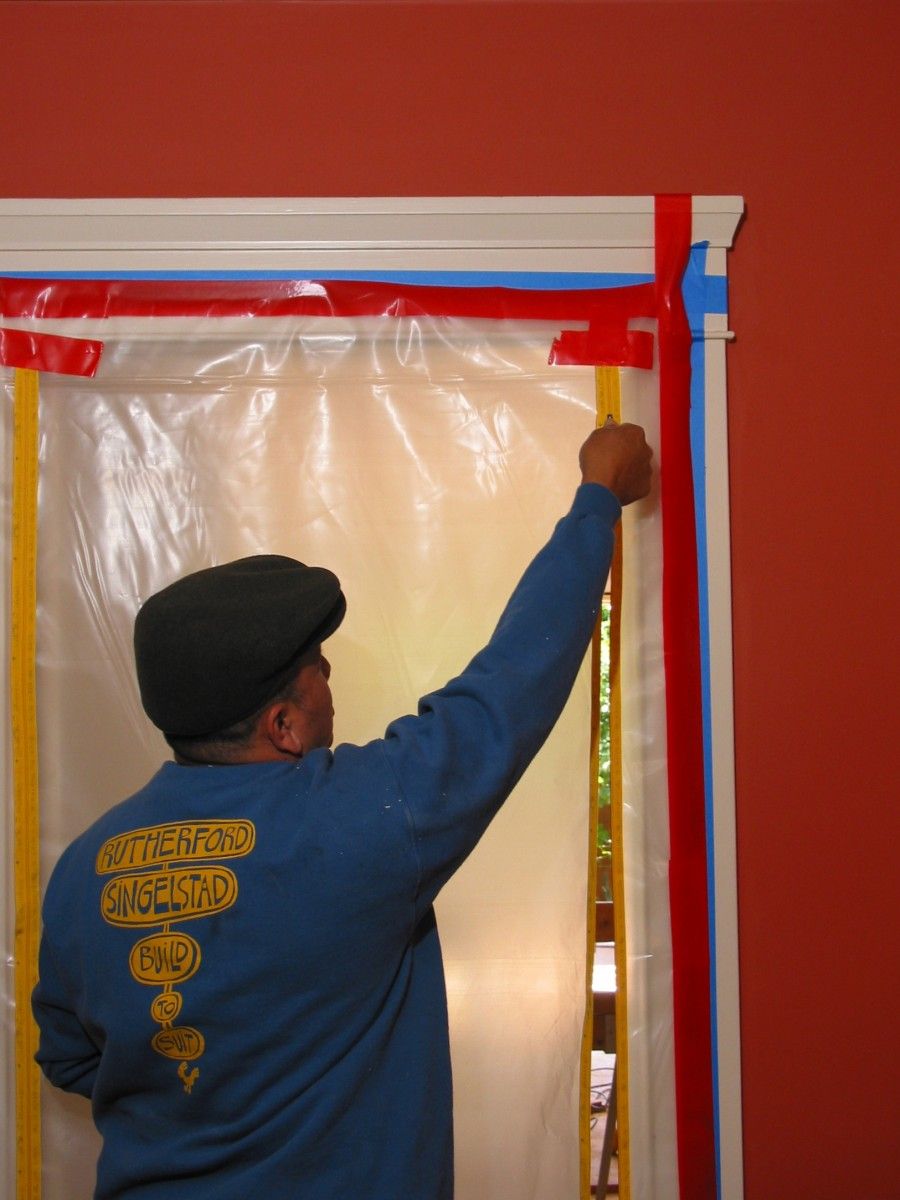
“On a really short job (a day or two) in which we make only a couple of cuts, we may use an expandable pole-and-plastic system. To be fair, they’re fast to put up but they’re not durable. If the poles get bumped you need to reset them, and it seems like you spend a lot of time taping and re-taping the zipper entry or repairing holes where somebody’s toolbelt snagged when he entered.
“The other big advantage of our temp walls over plastic is that they give both the homeowners and the workers a safety barrier and a visual barrier-and hence a modicum of privacy. The longer a project runs, the more important that sense of separation becomes. It’s stressful having strangers in your house all day. And for a worker, privacy means being able to take the time you need to think through a tricky detail without having a client looking over your shoulder wondering, ‘Why has he been scratching his head for the last five minutes?’
“Thinking is some of the hardest work there is and the best carpenters stop and think all day long.”
Thanks to Chip for this tip–just one of the thousands of field-tested tips and techniques that you’ll find in Renovation 4th Edition. Brand new from Taunton Press, R4‘s 614 pages include 250+ technical drawings, 1,000 photos selected from the 40,000 that I’ve taken over the years, and lifetimes of experience that builders shared with me. I hope you find it useful. -Mike
© Michael Litchfield 2013
-
Renovation 4th Edition contains lifetimes of experience: thousands of field-tested tips and techniques that master builders across North America shared with Mike Litchfield, a founding editor of Fine Homebuilding.
-
A zipped plastic entry is a good short-term way to isolate the mess of a renovation--but it's not durable and won't offer much privacy. Plus, if you leave the tape on past its day-rating it will lift off the finish.















View Comments
This is a useful tip, and I see its use as a temp wall, but because of the zippered plastic passageway comment, I'm unclear on how the author uses it as a temp door. Given the long term concerns of tape, how does the author accomplish a blemish free door in a bulkhead that doesn't offer hinges from which to hang a temp door?