A Conversation with Tedd Benson About the Road from Fine Carpenter to Fine Businessman

Tedd Benson, one of the most celebrated homebuilders in America, has been a leader in reintroducing the art of timber framing, and has continued to develop it using modern technology to create structures of lasting beauty and high efficiency. He also built a successful business, stalwart enough to sail through the Great Recession and expand. I recently had the opportunity talk with Tedd Benson and learn about his background, his business, and his plans for the future.
Tell us about your background, and how you discovered timber-framing.
I grew up in Colorado, the sixth of 11 children in a lower-income family, so I worked through high school doing construction, mostly heavy-equipment operation. This got me into the new developments around town where the carpentry was going on, which appealed to me. Back then, just being a young buck that could swing a big hammer was all it took get a job on a construction crew. I learned the rudiments of carpentry, but mostly how to swear and other crude things I didn’t learn at home. But it wasn’t until I moved to Boston where I had the chance to work with old-world craftsmen on historical buildings that I discovered the art of fine carpentry. We rehabilitated buildings 200 and 300 years old, lovingly repairing them because they were worth it. They were beautiful and functional, as all buildings should be.
I became enthralled with the large timbers, nail-free joinery, framing with the tolerances of fine furniture. I asked all the questions, who did this, what kind of tools did they use, why aren’t we doing this anymore? The guys knew the answers. They had inherited tools from their grandfathers and my keen interest sparked renewed interest among them. But they were older, and lives don’t last forever. Those experiences and connections led to another job, and then another, and before I knew it, without a plan, I was working for myself. I didn’t think I was in business, but I was.
I had decided I wanted to build with timber frames, as this craft should never have died, so I devoted myself to it in 1974. Five years later, I wrote a book about it, Building the Timber Frame House: The Revival of a Forgotten Art (Scribners, 1981). The purpose of the book was to get the word out, we were one of very few companies doing it back then, and we wanted many others to do it, too. For timber-framing to become a viable and living art, we needed an industry, not a few scattered zealots.
How did you develop such a high-profile brand and solid business?
Some of the most important things we do in life, like parenting and being a husband, we do with no education. This is what happened to me in business. I had no background, no education, and I even denied being in business. I would come into the office to answer the phone with my carpenter’s belt on. But I surrounded myself with really good people that filled in my gaps and helped me to overcome my deficits. Then a big thing happened in the late 1980s. I found myself stuck in a rut. After so much passion, I had lost my inspiration. It was getting heavy, and the business started getting in the way of our passion and progress. Two guys I had worked with for many years, really my best employees, came in late and dragging, and I was about to go into a rant and chew them out. And then, I don’t know why, I stopped myself and realized that the problem was me. We had built great homes, but not a good business.
I called my employees together and confessed my concerns about our business and my role. I announced I would take a sabbatical to figure it out. We had to create a good business, as well as do great craft. I thought it would take me about 10 days, but it was four months.
This was 1989. There was a lot of good literature about business then. It was the heyday of professional business management, and through reading and reading, I got as excited about the craft of business as I had become about timber-framing. I realized I was a good craftsman at heart, and this was another craft that I also could master. I did my own self-taught MBA.
When I came back to work, I pleaded guilty to my employees: “All these years, you have been doing things my way. I have been a bad leader. You have followed me, and I taught you the craft, but I also became a dictator.” I was a benevolent dictator, but we did not have a democratic structure. I said, “I don’t want to do this my way anymore, I want to find our way.” I reasoned that if timber-framing was an expression of a philosophy of life, we had to define our mission together and figure out what do we wanted to next and how.
The transition was not easy, but now we now have wonderful businesses, and not just a successful one. It has become an expression our values, not just Tedd’s values.
Do you have a mission statement?
Yes, but it’s not a snappy phrase. It’s an ecology, as complex as a Rubik’s Cube-like life. But if I were to say there’s a nut, it would be: “Through process and product, improving people’s lives.”
We just had a holiday party, and we are now celebrating people who have been with us 15, 25, and 30 years. We have 75 employees.
How about the recession?
This recession tested us. It’s easy to remain a magnanimous business in the good times, tough in the tough times. During these lean years, it’s not been about profit-sharing; it’s about splitting a proverbial six-pack between 75 employees. So we’ve put a lot of effort in investing in ourselves and looking at the future, which would not have been possible without the strong, “we’re all in this together” culture we developed. An organization is an organic thing. I may have set organization in motion, but then it created and re-created itself so that now I can no longer claim the credit. It has shaped me as much or more than I have shaped Bensonwood. It’s not just mine, but ours. It has the lasting strength of a tight-knit community.
What’s next?
People need to be able to afford great homes, and we’ve been building moderate-priced homes for a long time, although it’s not celebrated in architectural magazines. When we started, timber-framing was not well known, or even desirable. All of our clients were working people, teachers, police officers, and back-to-the-landers, and most were do-it-yourselfers as well. We’d build the shell, and they would finish it off, sometimes with our help. We were the local, affordable homebuilder. Only problem: We didn’t make a good living.
In the early ’80s, before my personal business eureka moment, we decided as a company that if we were really going to have a legitimate business and raise the craft to the level we wanted, we had to work on high-end homes, the best homes built in America. We made a conscious effort to get there. It meant things like hiring real architects, putting a real structural engineer on staff, and then focusing on the highest level of craft possible to deserve the position we sought.
We were successful. Bensonwood Homes moved into the high-end market, and has been building high-quality custom homes all over the United States. We developed all the requisite skills, and now we even make drop-dead beautiful furniture for our buyers. But we never forgot the original mission. We still sought ways to move down the market to make all of this viable and affordable for working people. The past six years have given us the opportunity to explore this market segment again with and without timber-framing. We now build turnkey homes for $200,000 to $400,000. But this still does not get press coverage; it’s known only locally.
How does this square with Bensonwood’s reputation as a millionaire’s builder?
It’s a contrast, so we bifurcated the company in October of last year, separating Bensonwood Homes from our new company, Unity Homes. We have a new image and marketing program, and a different team structure to bring our affordable objectives into clear focus.
The motivation remains both moral and financial. To start, it is the right thing to do. I have been saying for years, “I want to build a home my sister can afford.” It’s also a good business plan because the market has changed. The low end offers a much bigger market potential. While Bensonwood remains my namesake, the growth potential in the high end is limited. We require an enormous staff to realize every project. The Unity Home side has lower overhead overall and a much lower overhead on a per project basis.
Our concept is to raise the bar for what low-end homes can and should be, and then continue to work very hard to bring the cost down even further. We begin by bringing our typical quality homes to the market at a competitive level and then go further through scale and production. In Boston we’re a bargain with a highly insulated home, passive-house tight, no fossil fuel in the heating system, engineered for the worst hurricanes and earthquakes, and with as much of our legacy craftsmanship as possible within cost constraints.
You’re known as a green builder and designer. Talk about sustainability.
If we’re going to pursue sustainability – and we are – it cannot be a pursuit of energy efficiency alone. It has to include livability, beauty (which is a primary driver of durability), and affordability. I liken this to a kind of total frugality. We require frugality with finite resources, including the family budget. And although it’s the most salient issue today, energy frugality must be sought in concert with great design. It cannot stand alone as the only justification for any structure, because unless it’s beautiful and useful, it won’t stand the test of time.
I’m calling this holistic approach the Vitruvian Imperative, after Vitruvius, the great Roman architect, who wrote the first 10 books of architecture, which set all of architecture on an engineering and artistic course that continues today. Vitruvius also declared that good architecture requires a balance, or optimization, of beauty, function, and strength (venustas, utilitas, firmitas) which is our professional challenge, but if achieved, the results are truly timeless and therefore sustainable, like the 200- to 300-year-old structures that inspired me in the first place.
We’re rediscovering the truth in Vitruvius’s dictum of beauty, function, and strength today. And we’ve added parsus, or frugality as a fourth imperative to address the need for minimizing both economic and energy impacts. I believe this Vitruvian Imperative is perhaps the most important conversation we need to have across the industry. We have to learn to optimize those four critical aspects, instead of constantly compromising and maximizing one or two for the sake of one’s pet ideal. And most importantly, we have to pursue this imperative at scale, or we will have achieved little. The very concept of sustainability relies on the basic idea that buildings that will live in time as well as work in the present. And we need lots of them to make a difference. That’s why there’s no competition among green builders. It’s all about collaboration.
-
Tedd Benson has become one of the most celebrated homebuilders in America, having been one of the critical leaders in reintroducing the art of timber framing, and continued to develop it using modern technology to create structures of lasting beauty and high efficiency.
-
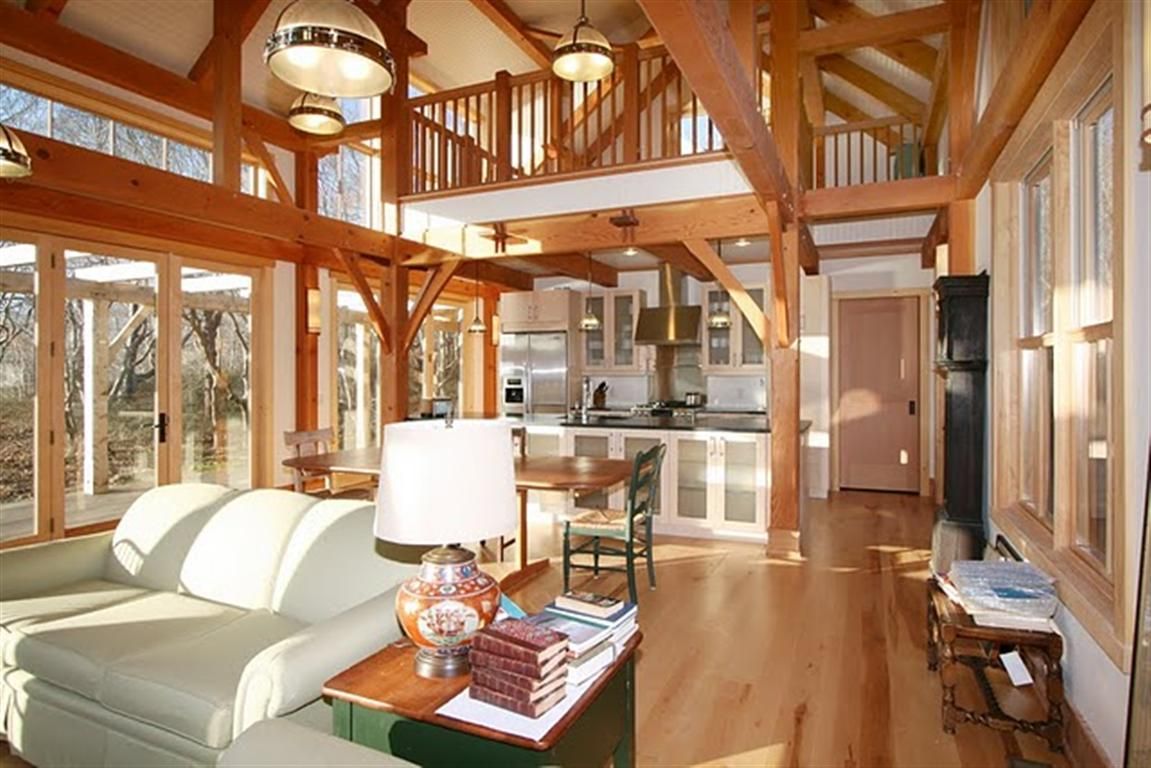
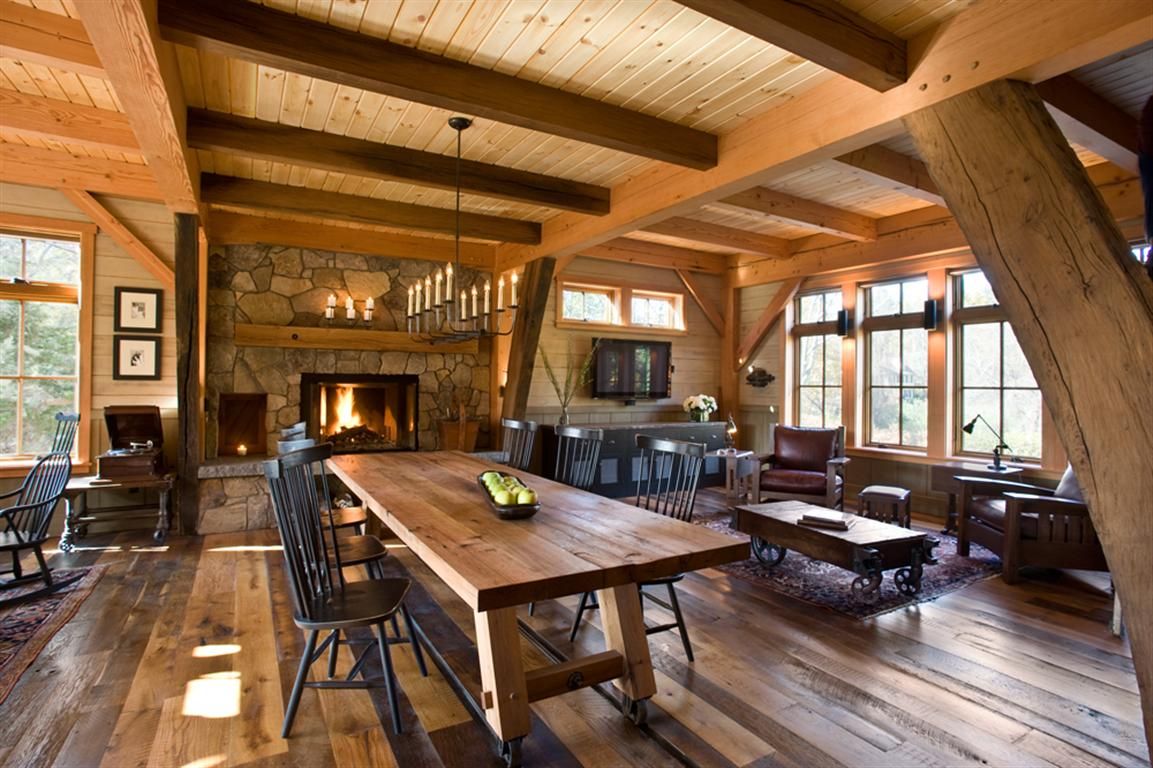
Bensonwood Homes pioneered the rich timber-frame home style, where structure is integral to the building's lasting beauty.
-
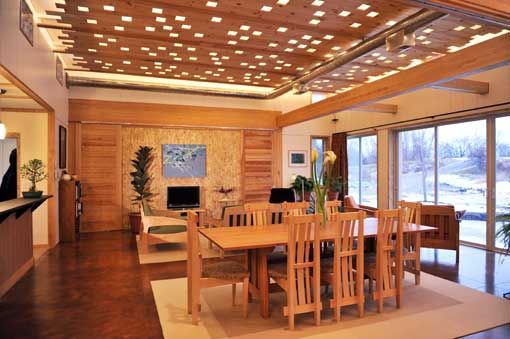
Some of Bensonwood's interiors are strikingly modern and architectural.
-
Bensonwood builds not only homes but also beautiful furniture, too, something architects such as Frank Lloyd Wright used to do.









View Comments
Thank you for the wonderful article. This man's work is incredible. He was featured on a season of This Old House they helped to build the Weston project timber-frame. It was awesome, and their workshop is amazing.
Excellent article! I love how Ted talks about a house needing beauty in order to be durable. Ugly houses are not cared for and ultimately don't last because no one cares for them. I'd be willing to bet these timber framed beauties last 300-400-500 years simply because they are unique and people will always resonate with the beauty of exposed wood structure. Thanks for sharing. Matt Risinger