previous
  • 13 Door Design and Installation Tips
    13 Door Design and Installation Tips
  • Roofing articles, videos, tools, and materials
    Roofing articles, videos, tools, and materials
  • How it Works
    How it Works
  • 7 Solutions for Kitchen Layout and Design
    7 Solutions for Kitchen Layout and Design
  • Deck Design & Construction Showcase
    Deck Design & Construction Showcase
  • Fine Homebuilding: The Digital Issues
    Fine Homebuilding: The Digital Issues
  • Guide to Paperless Drywall
    Guide to Paperless Drywall
  • 15 Coffered Ceiling Design Ideas and Tips
    15 Coffered Ceiling Design Ideas and Tips
  • 2012 HOUSES Awards
    2012 HOUSES Awards
  • Buyer's Guide to Decking
    Buyer's Guide to Decking
  • Complete Kitchen and Bath Guide
    Complete Kitchen and Bath Guide
  • Meet the Fine Homebuilding Project House!
    Meet the Fine Homebuilding Project House!
  • 9 Design Ideas & Tips for Concrete Countertops
    9 Design Ideas & Tips for Concrete Countertops
  • 10 Basement-Remodeling Tips and Techniques
    10 Basement-Remodeling Tips and Techniques
  • Energy-Smart Details
    Energy-Smart Details
  • 12 Remodeling Secrets Revealed
    12 Remodeling Secrets Revealed
  • The Inspector Game: Decking Dos and Don'ts
    The Inspector Game: Decking Dos and Don'ts
  • Painting Ideas, Tips, and Techniques for a Professional Finish
    Painting Ideas, Tips, and Techniques for a Professional Finish
  • Outdoor Kitchen Design Inspiration
    Outdoor Kitchen Design Inspiration
  • 7 Small Bathroom Floorplan Layouts
    7 Small Bathroom Floorplan Layouts
next
Theres a Better Way


Stud finder on a Chain

comments (1) January 9th, 2009 in Blogs        
jross john ross, Web Producer
11 users recommend

Video Length: 1:04
Produced by: John Ross


Leter from Dan Broadbelt, Robesonia, PA

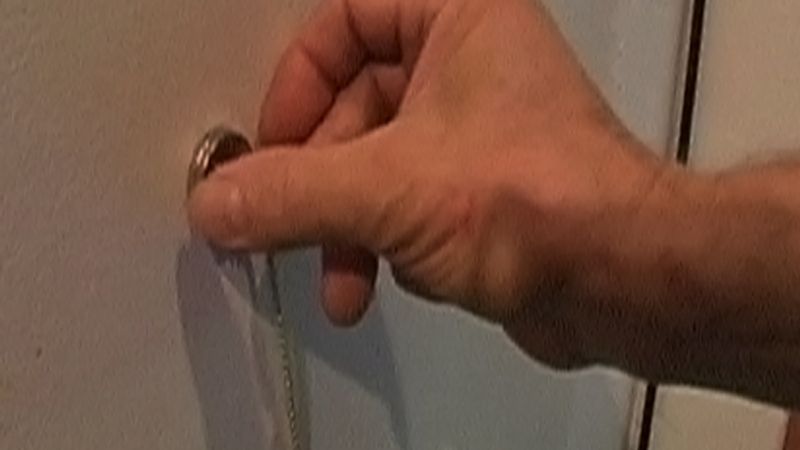
I have a store-bought, brand-name stud finder, but it is pretty much worthless finding studs in anything but new-work drywall. I’d heard about using a magnet, I tried it, and I was sold. As shown in the drawing, I took the idea one step farther by adding a length of brass chain (non-magnetic) like the type used for old-style toilets and a brass ball (for a pull-chain fan) at the end of the chain.
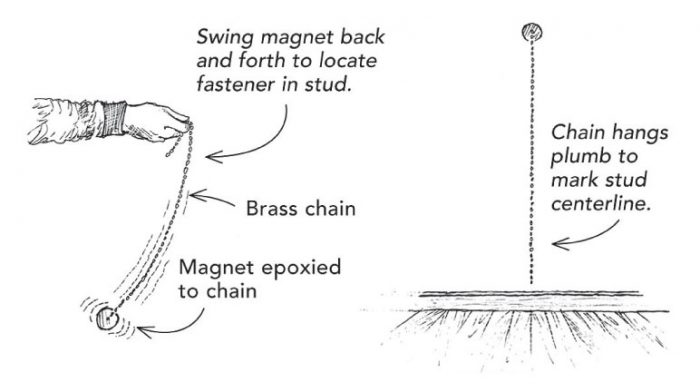
The beauty of this setup is that I can swing the magnet back and forth, and up and down in a slow, wide arc, and when a steel fastener is found, the magnet stops dead in its track. Then I drape the chain down the wall. When it stops swinging, the chain shows the center of the stud (usually). After that, I measure the stud centers (usually 16 in.) and start the process over again.

By the way, the magnets I use are from old computer disk drives. They are super strong. I attach the chain to the magnet with epoxy. I usually keep a couple of these stud finders with me—not because they break, but because when somebody else sees me using mine, they want one.


posted in: Blogs, remodeling, finish carpentry, measuring and marking tools

Comments (1)

JohnSprung2 JohnSprung2 writes: The only little drawback to these rare earth magnets is that they pick up any tiny particles of steel or iron that are anywhere nearby -- like from sawzalling thru nails. So, I keep mine in a small but thick-walled plastic bag that some parts came in. You can from time to time carefully pull the magnet out of the bag and thereby separate it from the magnetic crud it's picked up. The bag works well for dangling it, and is gentle on painted surfaces.


-- J.S.

Posted: 6:52 pm on November 9th

You must be logged in to post comments. Click here to login.