Fitting Coped Crown Molding
comments (6) July 16th, 2009 in Blogs
Video Length: 1:27
This tip comes to us from Colin Siddall of St. Paul, Alta., Canada:
Before I made this jig, I checked the fit of my coped crown molding the conventional way by climbing the ladder and holding the coped piece in place against the installed section. This method told me that it was either a good fit or that there was a gap, but it failed to tell me where to remove the material to eliminate a gap. All I knew was that there was a high spot or spots somewhere on the hidden coped surface. I then had to locate the high spots and remove them by trial and error, while chanting those special words carefully selected by carpenters to reflect their degree of frustration.
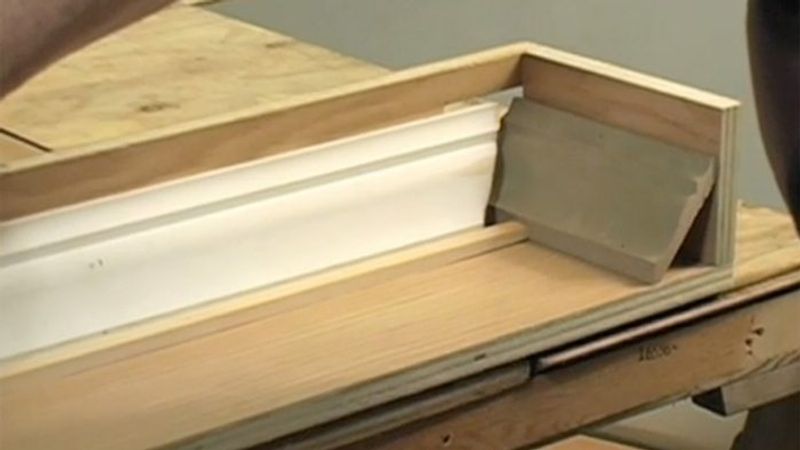
With this fixture, I am able to check my coping without climbing a ladder, and if it is not a good fit, I am able to see exactly where and how much material needs to be removed. I simply slide my coped section into the fixture until it engages the sample piece of crown, as shown in the drawing. If a gap exists between their front faces, I view the hidden coped face through the viewing window. This enables me to identify where and how much more fitting is required by the amount and position of the light shining through the gap. (High spots allow no light to show through.) I usually get all the high spots on the first go. The fit is confirmed by a quick recheck on the fixture, and it’s up the ladder for installation.
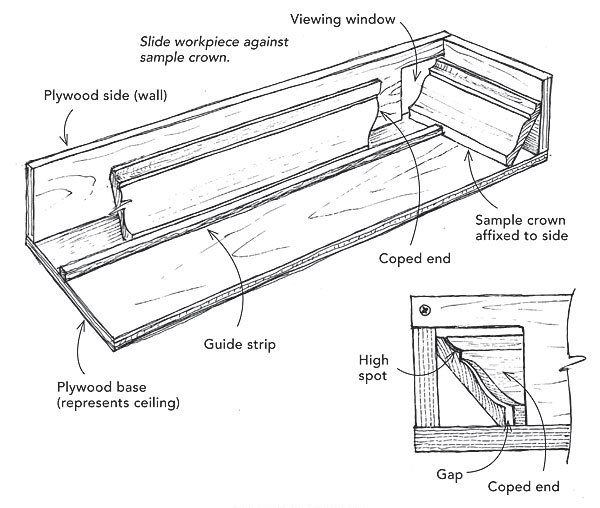
The installed sample and the guide position can be changed to suit the particular crown molding being
installed. Although I use separate left and right jigs, they can be modified easily to check both left- and right-hand coping by duplicating the window component—representing a wall and made of plywood—and attaching it to the front edge of the base together with the installation of a second guide.
Need more help on your crown molding project? Let Tucker Windover take you through the process in a Video Workshop by Fine Homebuilding.
posted in: Blogs, finish carpentry, crown-molding
|
|
-
How to Paint Fiber-Cement Siding
Painter Jim Lacey shares some tips for caulking and painting fiber-cement siding. read more
Are you a Tipster?
We're on the hunt for great reader tips to demonstrate online and include in the magazine.
If you have a tip that you would like to share, visit our new Readers Quick Tips blog to post text, photos, and links to videos. Or, send us an email at: quicktips@taunton.com
About this Blog
Have your ever been frustrated building something and mumbled to yourself, "There's got to be a better way."
Well, thanks to the contributions of our great Tipsters, and the talent of Fine Homebuilding Special Issues editor, Chuck Miller, help has arrived.
Each week, Chuck demonstrates a tip sent in by readers like you or something he learned on a jobsite.
So enjoy, and don't forget to come back each week for a new tip.
All How-To Topics


Comments (6)
Posted: 8:50 pm on March 6th
Do this and you'll quickly cut perfectly fitting copes every time. Fail to do this and you'll have to fiddle and fuss and custom fit every joint.
This technique is covered in an FHB article - http://www.finehomebuilding.com/how-to/departments/master-carpenter/coping-crown-molding-techniques.aspx
And Gary Katz's website, book and DVD's do an excellent job of demonstrating the technique.
Posted: 3:53 am on July 4th
Posted: 11:25 am on October 29th
Remember to get well acquainted with the process and installation of the crown molding. This will help you better understand how to install the molding. You may even want to watch some "how-to" videos as well.
It's important to take your time and follow the golden rule of molding, measure twice and cut onces.
Good luck!
- Mary
Posted: 2:47 pm on August 21st
Posted: 12:27 pm on August 7th
This jig seems mostly to addresses bad coping techniques, such as not enough angle being held on the coping saw to take out more of the bellies of the profile. The biggest problem with using this jig for fitting to walls is that it assumes that all your corners are a perfect 90 degrees. We all know that rarely happens. For fitting into the other 90% of the corners that one would see in the field, take the extra time to make a series of 24" test pieces with good copes that ranges from a 44.5 degree cut to a 45.5 degree cut, that is a decent range for most out of square corners. use some 18 gauge finish nails set at the spring point or snap lines at spring points with super fine chalk. Hold your straight piece up, then bring in your coped pieces to see which is the best fit. move them above or below the spring line to get your best fit, but not more than 1/8" in either direction or it will show looking down the wall lengthwise.
The best fit is your angle of cut and cope. When cutting the final pieces, cut it a full 1/16 of an inch long and snap it into place to get a super tight fit.
You still have to go up and down the ladder, but hopefully at least a couple of trips less cause you only cut your final piece once. Try a small rolling scaffold instead of the ladder as well, gives more working surface and easy to roll if on subflooring still.
Posted: 6:52 am on August 3rd
You must be logged in to post comments. Log in.